
A destination can look irresistible in photographs and still be completely wrong for the holiday you need. Perhaps everyone is recommending a busy city break when you are desperate for uninterrupted sleep. Or perhaps a secluded beach resort sounds appealing until you realise that several days without stimulation would leave you restless.
Choosing a holiday that genuinely suits you begins with identifying the experience you want, rather than selecting a fashionable destination and hoping it provides that experience. Your current energy, emotional needs, preferred pace and appetite for independence are more useful starting points than another list of must-visit places.
The aim is not to discover one permanent travel personality. Your preferences may change with your circumstances, and even contradictory desires can coexist. A carefully chosen holiday simply makes room for what matters to you now, within realistic limits of time, money and energy.
How to choose a holiday that feels right for you
- Identify what your everyday life is missing before deciding whether you need rest, stimulation, connection or independence.
- Choose three non-negotiable priorities and use them to assess destinations, accommodation and itineraries.
- Plan around your real energy levels, leaving enough flexibility to change direction without feeling that the holiday has failed.
- Why Do Some Travellers Crave Solitude While Others Seek Excitement?
- How to Identify Your Three Non-Negotiable Holiday Priorities?
- Wellness Retreat or Active Escape: Which Better Suits a Stressful Lifestyle?
- The Mistake of Planning Your Holiday Around Someone Else’s Bucket List
- When Should You Rethink Your Travel Priorities After a Life Change?
- Why Trying to Make Every Holiday Moment Perfect Often Backfires
- Why Do Fully Guided Tours Feel Restrictive to Some Independent Travellers?
- How to Plan a Balanced Trip With Enough Sightseeing and Time to Relax?
Why Do Some Travellers Crave Solitude While Others Seek Excitement?
Some travellers crave solitude because their everyday lives already demand constant attention, interaction or decision-making. Others seek excitement because their routines offer too little novelty, challenge or stimulation. These are possible responses to current circumstances, not fixed personality categories. Understanding what drains or energises you helps clarify which holiday experiences are likely to feel rewarding.
Consider someone who spends the working week managing meetings, family responsibilities and frequent interruptions. A quiet cottage, slow mornings and the freedom to decline social invitations might offer the greatest relief. Someone whose days feel predictable, however, might welcome a lively city, an outdoor challenge or opportunities to meet new people.
Neither traveller necessarily fits the familiar labels of introvert or extrovert. The more useful question is whether the holiday should compensate for something missing in daily life or provide distance from something overwhelming.
Foundational research by Sonnentag and Fritz distinguishes four experiences involved in recovery from work: psychological detachment, relaxation, mastery and control. Their Recovery Experience Questionnaire validation study provides a useful framework for reflecting on leisure, although it was not designed as a holiday-selection test.
Try answering three questions before searching for destinations:
- What am I missing in everyday life: quiet, novelty, connection, movement or freedom?
- What currently exhausts me: obligations, isolation, inactivity, uncertainty or constant decisions?
- What did I regret about previous holidays: doing too much, doing too little or following someone else’s preferences?
These informal prompts can help you distinguish a recovery-oriented holiday from a stimulation-oriented holiday, while recognising that many people want elements of both.
The destination itself does not settle the question. An island holiday could involve secluded walks and reading, or watersports and lively evenings. A major city could mean an intensive sightseeing schedule, or relaxed mornings spent in neighbourhood cafés and parks.
Once you understand the experience you are seeking, you can turn that insight into practical priorities that prevent attractive but unsuitable options from distracting you.
How to Identify Your Three Non-Negotiable Holiday Priorities?
Identify your three non-negotiable holiday priorities by listing everything you want, separating essential experiences from optional attractions, and keeping only the three requirements that most influence your satisfaction. Include where you want to go, what you want to experience and how you want your days to feel. Then use those priorities to evaluate actual travel options.
Start without editing yourself. Write down everything that comes to mind: sunshine, cultural discovery, privacy, good food, adventure, affordability, comfortable accommodation, freedom from driving or time together as a family.
Next, challenge each item with a simple question: Would the holiday still feel worthwhile without this? If the answer is yes, the item may be desirable rather than essential. This distinction matters because every additional requirement reduces your flexibility and increases the likelihood of disappointment.
Finally, choose just three priorities. A useful way to clarify them is to distinguish three dimensions:
| Priority type | Question to ask | Example |
|---|---|---|
| Place | Where do I need or want to be? | Somewhere accessible by train |
| Experience | What must I do or avoid? | Spend time walking outdoors |
| Pace | How should each day feel? | Unhurried, with no early starts |
These categories are decision-making aids, not a requirement to select exactly one from each. Two of your three priorities might concern the same dimension. The important point is to avoid confusing a destination with the benefit you expect it to deliver.
For example, a traveller may insist on visiting a particular coastal town when the real requirement is a quiet location with easy access to the sea. Recognising this opens up several alternatives.
As a practical rule of thumb, reject an optional travel deal or suggestion if it fails to satisfy at least two of your three priorities. However, treat genuine constraints such as accessibility, safety and affordability as mandatory conditions rather than negotiable scoring criteria.
Your five-step holiday priorities checklist
- Write down everything you currently want from a holiday. Deliverable: an unfiltered wish list.
- Mark each item as essential or optional. Deliverable: two clearly separated groups.
- Choose your three strongest essentials and state the benefit of each. Deliverable: three one-sentence priorities.
- Compare two realistic holiday options against those priorities and your practical constraints. Deliverable: a simple comparison grid.
- Select the better-fitting option or revise your shortlist if neither works. Deliverable: a written decision and the main reason behind it.
These priorities become particularly valuable when deciding between very different holiday styles, such as a restful retreat and an activity-focused escape.
Wellness Retreat or Active Escape: Which Better Suits a Stressful Lifestyle?
A wellness retreat may suit someone overwhelmed by constant demands who wants fewer decisions, quieter surroundings and opportunities to disconnect. An active escape may appeal more to someone frustrated by sedentary routines who finds movement and achievable challenges rewarding. Neither is automatically better for stress: the right choice depends on your energy, health, preferences and desire for structure.
Think first about the character of your stress. Mental overload may make a peaceful setting, restorative sleep and unstructured time particularly appealing. A sense of stagnation or lack of physical activity may make walking, cycling or learning a new outdoor skill more satisfying.
Both forms of recovery can have value. A 2025 meta-analysis of vacation and employee well-being, published in the Journal of Applied Psychology, examined 32 studies and 256 effect sizes in its main analysis. It reported substantial overall benefits associated with vacations, while a separate analysis identified psychological detachment and physical activity as potentially beneficial experiences.
32 studies
The main 2025 meta-analysis examined changes in employee well-being associated with holidays across 32 studies and 256 effect sizes. It did not establish that one type of holiday is best for every traveller.
Grant, Buchanan and Shockley, Journal of Applied Psychology, 2025.
However, the label “wellness” does not guarantee that a programme will feel restful. A retreat with mandatory early starts, tightly scheduled sessions, enforced silence or restrictive eating arrangements could create additional pressure for someone who already feels controlled by obligations.
Likewise, an ambitious hiking itinerary may be invigorating for one traveller but overwhelming for someone experiencing exhaustion, pain or limited physical capacity. Activity should match individual abilities rather than become another performance target.

If neither option feels quite right, look for a hybrid holiday: gentle morning activities followed by afternoons without commitments, or an accessible walking holiday with comfortable accommodation and optional rest days.
Read programme descriptions carefully. Look for clear indications that activities are optional, realistic descriptions of their physical demands, unscheduled periods and opportunities to adjust participation. The phrase “free time” is less useful than a timetable showing when that freedom exists.
The best fit is one that supports your chosen form of recovery without imposing another set of expectations. That distinction becomes even more important when those expectations come from other people’s travel aspirations.
The Mistake of Planning Your Holiday Around Someone Else’s Bucket List
Planning a holiday around someone else’s bucket list can leave you spending time and money on experiences that look impressive but hold little personal meaning. Famous landmarks, viral destinations and recommendations from friends are useful sources of inspiration, not obligations. The mistake occurs when their popularity becomes a substitute for examining your own interests and needs.
Social media makes comparison particularly easy. A picturesque viewpoint or luxurious hotel may seem essential after repeated exposure, even when the actual experience involves crowds, long journeys or a pace that conflicts with your preferred holiday.
There is a difference between discovering something through another person and wanting it mainly because that person has experienced it. The first can broaden your interests. The second can turn your holiday into a form of social performance.
A 2026 study published in Frontiers in Psychology surveyed 465 adults who had recently taken leisure trips and shared travel-related content online. The researchers found associations between impression-focused posting, greater posting anxiety and lower retrospective trip satisfaction. These relationships were especially relevant among participants more inclined towards social comparison. The Frontiers in Psychology study on the “Perfect Trip” and social comparison does not prove that social media causes poor destination choices, but it highlights a possible emotional cost of treating travel as a performance.
Before adding a fashionable destination to your shortlist, ask yourself: Would I still want to go if nobody knew I had been there? Then try describing the appeal without referring to a photograph, influencer or list of famous attractions.
If you cannot explain what you personally hope to experience, investigate further before committing. Perhaps you genuinely value the architecture, history or landscape. Perhaps an entirely different destination would meet the underlying desire more comfortably.
Travelling with others adds another dimension. One person may want iconic sights while another values leisurely meals and privacy. Rather than allowing the most enthusiastic planner to determine the entire itinerary, ask each traveller to identify their essential experiences beforehand.
Agree on shared activities, acceptable compromises and occasions when people can pursue separate interests. A group holiday does not require everyone to participate in every activity, provided expectations and practical arrangements are clear.
Your ideal holiday is not necessarily unusual or undiscovered. It is simply one whose attractions make sense for you, including when your interests differ from those you had a few years ago.
When Should You Rethink Your Travel Priorities After a Life Change?
Reconsider your travel priorities after a significant change in health, family responsibilities, relationships, working life or available energy. Such transitions can alter what feels enjoyable, manageable or restorative. A preference that suited an earlier chapter of life may no longer fit, even if you still associate it with some of your happiest travel memories.
Becoming a parent may introduce new requirements around sleep, transport and flexibility. A career change might increase your need for quiet or, conversely, your appetite for exploration. Separation, retirement, an empty nest or changing physical abilities can also reshape the purpose of time away.
These transitions do not dictate a particular holiday style. Parenthood does not eliminate adventure, and retirement does not automatically create an interest in slow travel. Their significance lies in the possibility that your previous assumptions deserve reconsideration.
One useful warning sign is repeated dissatisfaction across different destinations. If your last two or three holidays produced similar frustrations despite changing locations, the issue may involve your expectations or preferred pace rather than geography.
For example, imagine someone who once enjoyed moving between several cities over a week. After taking on more demanding responsibilities, that traveller continues booking intensive itineraries but repeatedly returns feeling exhausted. Choosing another city may not resolve the problem. Reducing travel days and allowing longer stays might be more relevant.
This is a hypothetical illustration, not evidence that every busy traveller should slow down.
After a major transition, repeat the three-priority exercise. Compare your former preferences with your current ones and note what has changed. Consider whether you still want the same level of nightlife, luxury, independence, physical challenge or social interaction.
It may also help to test a revised preference on a shorter trip before committing to a longer or more expensive holiday. Preferences evolve through experience, not reflection alone.
Revising your expectations is not abandoning your travel identity. It is recognising that a worthwhile holiday should serve the person you are today, rather than an idealised version of your past self.
Why Trying to Make Every Holiday Moment Perfect Often Backfires
Trying to make every holiday moment perfect can backfire because constant optimisation creates more decisions, comparisons and opportunities for regret. A tightly managed itinerary may look efficient but leave little freedom to respond to tiredness, unexpected discoveries or changing interests. A satisfying holiday usually requires thoughtful preparation alongside permission for some moments to be ordinary.
When every restaurant, attraction and hour must be the best available, planning can become a continuous search for alternatives. Even after making a decision, you may wonder whether another choice would have delivered a better experience.
Psychological research on maximizing versus satisficing decisions, published by Schwartz and colleagues in 2002, found that stronger maximising tendencies were associated with greater regret and lower satisfaction in several decision-making contexts. This research did not specifically test holiday itineraries, but it offers a useful explanation for why endlessly pursuing the perfect option may feel unrewarding.
Holiday planning creates particularly tempting opportunities to maximise. There are countless hotels, restaurants, scenic routes and attractions to compare, while reviews and photographs make alternatives constantly visible.
Consider a traveller who schedules every hour of a city break. A delayed train or unexpectedly long museum visit can then threaten several subsequent bookings. The itinerary becomes a sequence of obligations rather than a guide to enjoyable possibilities.
A more forgiving approach separates essential commitments from flexible choices. Arrange critical transport, accommodation and any high-priority attractions requiring advance booking. Leave less important activities open until you know how you feel on the day.
Unscheduled time can accommodate a longer lunch, an unexpected conversation or simply an afternoon indoors when you are tired. Such moments are not guaranteed to become memorable, but flexibility allows you to respond to them without constantly recalculating your plans.
The aim is not to avoid all planning. Travellers with accessibility requirements, limited time or complex transport connections may benefit from additional preparation. Even then, building realistic margins into the schedule can reduce unnecessary pressure.
Once your essential arrangements are secure, allowing space for uncertainty can make the holiday feel more like time off. The same principle helps explain why some travellers resist fully guided itineraries.
Why Do Fully Guided Tours Feel Restrictive to Some Independent Travellers?
Fully guided tours can feel restrictive to independent travellers because they transfer control over timing, activities and daily decisions to a group schedule. Fixed departure times, collective waiting and limited opportunities to explore spontaneously may conflict with a traveller’s need for autonomy. Other people find the same structure reassuring, convenient or essential for learning and access.
For someone who values independence, the hidden cost of a guided tour is not necessarily financial. It is the inability to stay longer in a favourite place, leave when an activity loses its appeal or change plans based on energy levels.
A guided group may spend time gathering participants, coordinating meals or following an itinerary that offers little room for individual interests. A traveller who dislikes being rushed could experience these constraints as tiring, even when the destinations themselves are excellent.
However, the opposite experience is equally possible. Someone exhausted by constant decision-making may welcome having transport, accommodation and logistics organised. A knowledgeable guide can also make unfamiliar historical, cultural or natural sites more accessible and meaningful.
Rather than deciding that guided travel is inherently better or worse, evaluate which responsibilities you prefer to retain and which you would gladly delegate.
Several intermediate options provide a useful compromise:
- Private local guides: concentrated expertise for a particular visit without surrendering control of the entire trip.
- Optional day excursions: organised access to selected experiences while leaving other days free.
- Self-guided packages: prearranged accommodation, routes or transport with more independence over daily activities.
Read the details before booking. Confirm whether departure times are fixed, how much independent exploration is allowed and which transfers or activities are compulsory. The description “small group” does not necessarily mean a flexible itinerary.
If safety considerations, language barriers, specialist knowledge or access restrictions make independent travel difficult, a guided option may deliver substantially more value than it removes. The relevant measure is whether it supports your three priorities.
With the right level of guidance established, the remaining task is to organise individual days so that sightseeing, travel and recovery work together instead of competing for your attention.
Key takeaways before building your itinerary
- Translate each priority into a scheduling decision: a late start, an optional excursion or sufficient time in one location.
- Protect the experiences that matter most, but do not give optional attractions the same status as essential commitments.
- Build flexibility around your energy and practical constraints, especially when travelling with others.
How to Plan a Balanced Trip With Enough Sightseeing and Time to Relax?
Plan a balanced trip by alternating activities that require energy with periods that allow you to recover. Include transport, queues and check-ins when estimating how demanding each day will be. Rather than dividing the entire holiday into sightseeing days and rest days, create a manageable rhythm within individual days and adjust it as your energy changes.
Start by reviewing the activities on your itinerary. Classify each one according to its likely effect on your energy, rather than whether it sounds enjoyable. A museum visit might be relaxing for someone who loves art but tiring for someone overwhelmed by crowds. A morning hike might feel restorative to an experienced walker but physically demanding to someone unaccustomed to exercise.
Two simple categories help make this distinction:
- Energy expenditure: demanding sightseeing, challenging physical activities, lengthy transfers, crowded attractions or experiences requiring sustained concentration.
- Recovery: unhurried meals, quiet walks, free afternoons, relaxed swimming, reading or other activities that personally help you unwind.
A balanced schedule alternates these categories throughout the day. For example, a morning spent visiting a major attraction could be followed by lunch without a reservation and an afternoon with only one optional activity.
Importantly, transitions count towards your daily workload. Travelling between attractions, finding transport, waiting in queues and checking into accommodation can consume considerable time and attention. An itinerary containing only three scheduled visits may still feel exhausting if each requires a complicated journey.
Consider a hypothetical four-day city break. Instead of booking multiple major attractions every day, the traveller allocates the first afternoon to arriving and settling in, combines one substantial sightseeing activity with a flexible afternoon on the second day, allows a slower start on the third, and keeps departure day free of time-sensitive visits. The precise arrangement should reflect transport constraints, opening times and individual preferences.
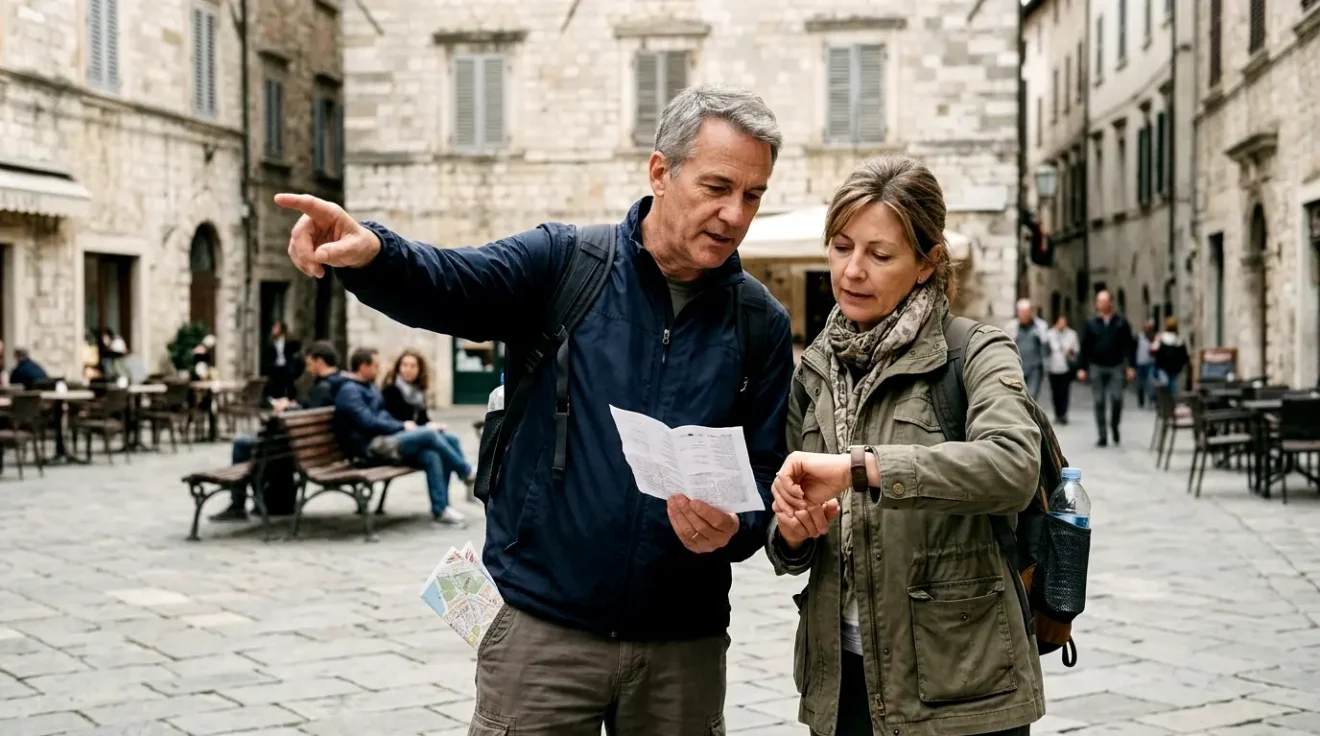
At the midpoint of your holiday, introduce a simple check-in: “Do I genuinely want to continue at this pace, or would slowing down improve the remaining days?” This question is more useful than judging whether you have completed enough activities.
If you feel energised, you might explore somewhere new. If you are tired or increasingly irritable, consider removing a lower-priority activity, extending a break or simplifying the following day. When travelling with companions, discuss these adjustments openly rather than assuming everyone has the same energy level.
There is no universally ideal ratio of sightseeing to rest. Your balance will depend on the purpose of your holiday, physical abilities, the needs of your companions and the demands of the destination. A short cultural break may reasonably involve more scheduled activities than a holiday primarily intended for recovery.
The most useful measure is not how many attractions you visit but whether the experiences remain enjoyable and compatible with your original priorities. An unfinished itinerary is not necessarily an unsuccessful holiday.
Before booking your next trip, write down the three experiences or conditions that would make it worthwhile, choose a destination that can accommodate them, and sketch a flexible first day. You do not need to predict every moment of your holiday. You only need to create the conditions for spending your time in a way that genuinely matters to you.
What if I genuinely do not know what kind of holiday I want?
Start with what you want to avoid rather than trying to imagine the perfect trip. Think about previous holidays that felt tiring, disappointing or frustrating, and identify the conditions you would change. Then explore a few contrasting possibilities, such as a quiet countryside stay and a lively cultural break. A short, affordable trial trip can help reveal your preferences without requiring a major commitment.
Should I choose a destination or a holiday experience first?
For a holiday focused on personal fulfilment, identifying your desired experience first often produces more relevant choices. Decide whether you want relaxation, discovery, connection, independence or physical activity, then look for destinations that make those experiences possible. However, if you have a specific family obligation, event or place you particularly want to visit, the destination can reasonably come first. In that case, adapt the activities and pace to your needs.
Can a holiday combine completely different travel preferences?
Yes. A holiday can combine quiet mornings with adventurous afternoons, guided cultural visits with independent exploration, or social activities with personal downtime. The important consideration is whether these experiences complement one another within your available time and energy. Avoid assuming that every day must contain every preferred activity. Some variety can be enjoyable without making the itinerary unnecessarily demanding.
How can I avoid regretting my holiday choice after booking?
Evaluate your choice against the priorities you identified before booking, rather than continually comparing it with alternatives afterwards. Make sure essential requirements, practical constraints and cancellation conditions are acceptable before committing. Once those checks are complete, limit unnecessary browsing of competing offers. No destination can guarantee a perfect experience, and the existence of another attractive option does not mean your original decision was wrong.
Is staying close to home a valid alternative to travelling abroad?
Absolutely. If your principal needs are rest, freedom from obligations, nature or meaningful time with loved ones, a holiday closer to home may satisfy them without the additional demands of international travel. The key distinction is between remaining in your usual routine and creating an experience that supports your priorities. For some travellers, distance offers valuable psychological separation; for others, the right activities and boundaries matter more than how far they travel.