A photograph can show the beach where you watched the sunset, but it rarely captures the warmth of the evening air, the music drifting from a nearby café, or the conversation that made you wish the night would last longer.
Preserving lasting travel memories means keeping more than a visual record. It involves capturing sensory impressions, recording personal reflections, protecting meaningful photographs, and turning individual experiences into stories you can revisit. Even a few minutes of deliberate attention each day can create a richer record of a journey than hundreds of unexplained images.
The most useful approach combines several small habits rather than demanding a complicated travel diary or endless documentation. A distinctive sound, an honest sentence, a carefully chosen photograph, or a message to someone you met can become a way back into an experience years later.
What matters is not remembering every destination perfectly. It is preserving enough of the atmosphere, relationships, and personal meaning to recognise why the journey mattered.
How to make travel memories last
- Record one sensory detail and a short personal reflection each day to preserve the atmosphere and emotional meaning of your experiences.
- Choose photographs deliberately, organise them into a meaningful story, and keep independently verified backups.
- Protect time for unexpected encounters, maintain relationships formed abroad, and turn defining moments into stories worth sharing.
- Why Do Holiday Smells and Sounds Trigger Memories Years Later?
- How to Keep a Five-Minute Travel Journal During a Busy Holiday?
- Printed Photo Book or Digital Album: Which Better Preserves a Family Trip?
- The Photo Backup Mistake That Can Erase an Entire Holiday Album
- How to Turn a Long Journey Into a Personal Travel Story Worth Sharing?
- How to Capture Holiday Highlights Without Spending the Trip Behind a Screen?
- How to Keep in Touch With People You Meet During a Long Journey?
- How to Create a Memorable Vacation Without an Overpacked Itinerary?
Why Do Holiday Smells and Sounds Trigger Memories Years Later?
Holiday smells and sounds can bring back memories years later because sensory cues become associated with the emotions and circumstances of an experience. Encountering a familiar scent or melody may reactivate those associations, making a forgotten moment feel unexpectedly close. These cues complement photographs by recalling aspects of a place that images cannot fully capture.
Imagine walking past a bakery at home and suddenly remembering an early morning in Lisbon. The smell of warm pastries may bring back the narrow street, the conversation you were having, and the anticipation of exploring an unfamiliar city.
Smell has particularly close neurological connections with brain regions involved in emotion and memory, including the amygdala and hippocampus. Sound also provides powerful contextual cues: a particular song, station announcement, or rhythm of waves can become associated with a memorable experience.
A 2026 meta-analysis of odor-evoked autobiographical memory examined 18 experimental or quasi-experimental studies. It found that odours could evoke autobiographical memories with greater emotional intensity, pleasantness, and evocative qualities than other types of cues. However, the advantage was selective, not universal, and the research did not specifically investigate travel experiences.
Rather than expecting every scent to unlock a vivid recollection, travellers can deliberately collect small sensory reminders.
- Notice one smell: fresh sea air, toasted spices, pine trees after rain, or bread from a neighbourhood bakery.
- Identify one sound: a market vendor’s call, evening church bells, local music, or the atmosphere of a busy station.
- Record the association: write where you were, what was happening, and how the moment felt.
A simple sensory log might read: “Wednesday evening, coastal village. Salt in the air, fishing boats knocking against the harbour wall, and a feeling of complete calm.”
At home, a locally purchased spice can become a cooking ingredient, an ambient recording can bring back a street’s rhythm, and a familiar recipe can reconnect a journey with everyday life. Combining these cues creates several possible routes into the same memory, although research does not establish that multisensory recreation always produces stronger or longer-lasting recollections.
Photographs preserve appearances; sensory notes preserve additional clues about how being there felt. The next step is giving those fleeting impressions a place to live before they fade.
How to Keep a Five-Minute Travel Journal During a Busy Holiday?
A five-minute travel journal works best when it captures three essential details: what happened, how you felt, and one sensory impression. Write at a consistent moment, preferably in the evening, without worrying about perfect sentences. A handful of honest lines can preserve personal context that photographs alone may not explain months or years later.
Traditional travel journaling can feel demanding after a long day of walking, navigating unfamiliar transport, or travelling with children. The solution is to reduce the task until it becomes almost impossible to postpone.
Use this practical five-minute structure:
- First minute — choose the moment. Identify one experience worth remembering rather than summarising the entire day.
- Next two minutes — describe it. Write what happened and why it affected you.
- Fourth minute — capture a sensory clue. Add a smell, sound, texture, or taste.
- Final minute — add a memory prompt. Mention a person, place, or photograph that will help you recognise the moment later.
For example: “We missed the last ferry and spent an unexpected evening by the harbour. At first it was frustrating, but the quiet conversation over dinner became my favourite part of the day. I remember the salty breeze and distant music.”
This structure is an editorial technique rather than a scientifically established optimal journaling duration.
Timing may nevertheless matter. A study on diary timing and autobiographical memory involving 109 participants found that those who recorded personal experiences in the evening before sleep performed best in a memory assessment 30 days later, compared with the other recording schedules studied.
For travellers, writing before bed is therefore a reasonable starting habit. If evenings are unpredictable, choose a dependable alternative, such as breakfast or waiting for a train. The priority is making the routine sustainable, without assuming all recording times have identical effects.
A messy journal is better than an abandoned one. Missed a day? Continue with the next entry. Short on energy? Record three phrases. Voice notes can also help when writing is inconvenient.
These fragments become surprisingly useful later. A remark about your child’s excitement can become a family photo-book caption. A description of a difficult border crossing might provide the beginning of a personal travel narrative. A remembered joke can help reconnect with someone you met.
Once reflections and sensory details are recorded, they can give photographs something they often lack: a story about the people behind the images.
Printed Photo Book or Digital Album: Which Better Preserves a Family Trip?
Neither a printed photo book nor a digital album is universally better for preserving family travel memories. Digital albums are convenient for storing, searching, and sharing large collections. Printed books encourage deliberate selection and provide a physical object families can enjoy together. The strongest practical approach often combines a protected digital archive with a carefully edited printed story.
After a family holiday, a phone may contain thousands of photographs: repeated landscapes, blurred portraits, meals, street scenes, and countless attempts to capture the perfect group picture.
The challenge is not simply keeping those images. It is making them easy to revisit and meaningful to the people who appear in them.
Consider the different strengths of each format before choosing.
| Decision factor | Printed photo book | Digital album |
|---|---|---|
| Number of photographs | Best for a curated selection | Suitable for large collections |
| Sharing with relatives | Ideal for in-person storytelling | Convenient for remote sharing |
| Revisiting with young children | Physical pages support shared browsing | Accessible on suitable devices |
| Searching for specific moments | Limited to the book’s organisation | Often supported by search and sorting tools |
| Long-term preservation | Requires appropriate physical care | Requires reliable backups and continued access |
| Milestone trips | Creates a lasting keepsake | Preserves a broader record of the event |
For a multigenerational family holiday, a printed book might be especially appealing because children and grandparents can turn its pages together without navigating an app. A digital archive, meanwhile, can retain photographs that would never fit in the printed edition.
The greatest advantage of a photo book may lie in the process of making it.
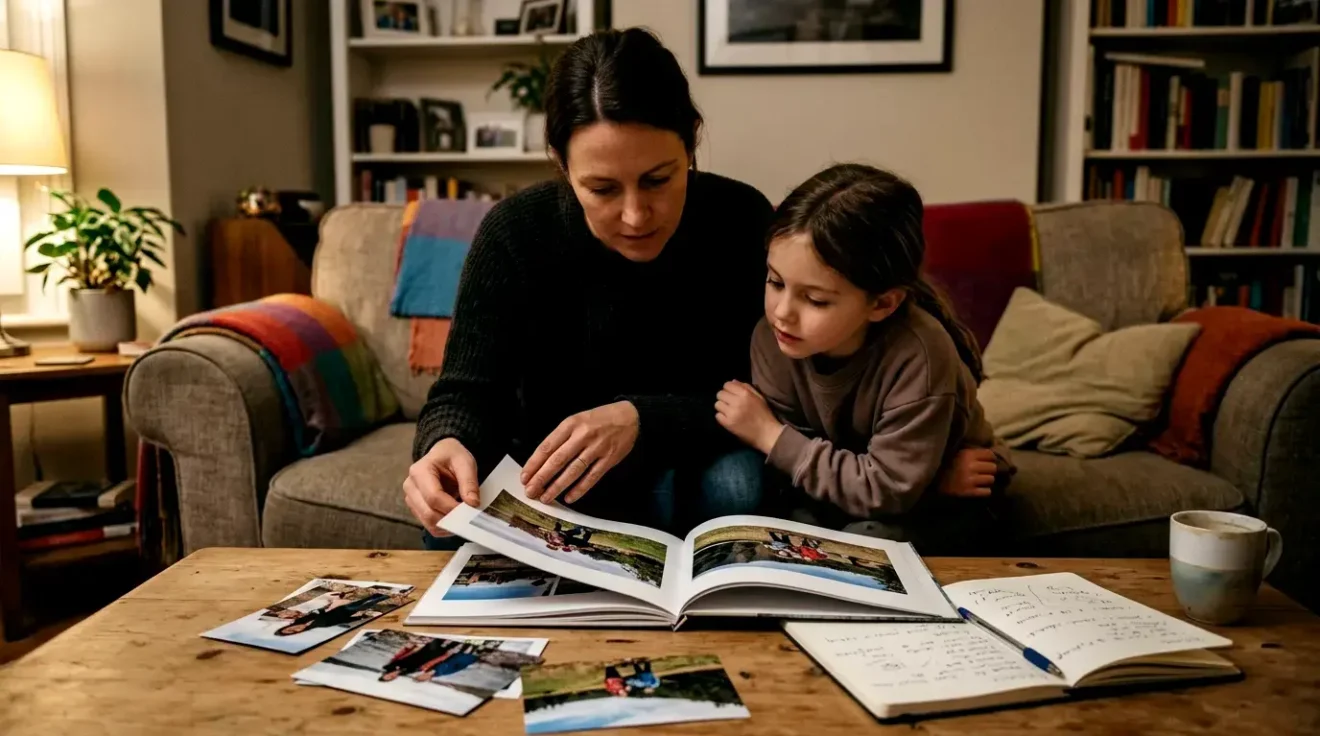
Imagine selecting 80 photographs from a collection of 2,000. Those figures are merely illustrative, but the editorial challenge is familiar: deciding which moments deserve space encourages family members to remember conversations, compare perspectives, and explain why particular experiences mattered.
Instead of organising the book only by location, consider chapters such as “The Day Everything Went Wrong”, “Unexpected Discoveries”, and “Our Favourite Evening”. Use journal entries as captions to explain emotions and circumstances rather than repeating what is visible.
A photograph of a restaurant becomes much more personal when its caption says, “This was where everyone finally stopped rushing, and we spent two hours telling stories.”
Keep the complete collection in an organised digital archive, and create a smaller printed edition for shared storytelling. There is no reliable basis here for claiming printed books are always revisited more frequently; family habits and accessibility will influence which format receives more attention.
Whichever format becomes your favourite, its value depends on preserving the original files securely. A beautiful collection is only reassuring when its underlying photographs are protected.
The Photo Backup Mistake That Can Erase an Entire Holiday Album
The most dangerous travel photo backup mistake is relying on a single storage location without verifying that a separate backup exists. A phone, cloud account, or external drive can fail, become inaccessible, or lose files through accidental deletion. Genuine protection requires independent copies, a repeatable backup routine, and occasional checks that saved photographs can actually be recovered.
Many travellers assume their pictures are safe because a cloud backup setting is switched on. Others copy everything to one portable drive and immediately delete the originals.
Neither approach necessarily provides sufficient protection. A cloud service may have exhausted its storage allowance, a transfer may have failed, or synchronisation settings may cause a deletion to spread between connected devices.
A useful framework is the 3-2-1 backup principle, recommended in an Australian Cyber Security Centre ransomware advisory.
- Three copies: retain the working collection and two additional copies of important photographs.
- Two storage types: use different forms of storage, such as a phone and an external drive.
- One off-site copy: keep at least one copy physically separate from the others, with protection against shared risks.
For a traveller, a practical arrangement might involve photographs on a phone, an independent copy on an external drive, and another recoverable copy in a cloud backup service. This is an example, not a guarantee: the devices must actually contain the files, and cloud synchronisation must not compromise copy independence.
Keeping a memory card and phone together in the same bag is not adequate protection against losing that bag. Similarly, two synchronised folders may not behave as independent backups when deletions propagate automatically.
The overlooked step is verification. Check the backup’s completion status and available storage, then open a selection of copied images and videos from the backup location. Before deleting any originals, confirm the intended files are present and can be recovered. Opening a few files is a useful check, although it does not replace testing the recovery of the full collection.

Be especially cautious with options labelled “delete”, “remove from device”, or “free up space”. Their behaviour depends on the particular application and configuration. Some actions remove local files while retaining cloud copies; others delete synchronised photographs across devices.
Read the service’s instructions and check its deletion and recovery behaviour before making permanent changes. A full cloud account or interrupted upload should also prompt a backup-status check rather than an assumption that everything has transferred.
Five actions for a safer travel photo archive
- Identify where your original photographs are stored and write down the primary location.
- Create an additional independent copy and confirm the destination contains the expected folders.
- Establish a physically or logically separate backup and record where it can be accessed.
- Open selected images and videos from the backup, then complete a recovery test and note the result.
- Check synchronisation, storage capacity, and deletion settings before freeing phone space; keep a short record of the verified configuration.
A dependable archive protects the raw material of your journey. Once that foundation is secure, the more creative challenge begins: deciding which experiences deserve to become a lasting story.
How to Turn a Long Journey Into a Personal Travel Story Worth Sharing?
To turn a long journey into a compelling personal travel story, focus on what changed rather than listing every destination. Choose a defining moment, identify a challenge or surprise, and describe the perspective you gained. Use journal notes, sensory impressions, and selected photographs to build a narrative that feels personal, coherent, and relevant to its intended audience.
A travel itinerary explains where someone went. A travel story explains why the experience mattered.
Consider the difference between these two openings:
“We visited three cities, took several trains, and spent the final week on the coast.”
“The day our train broke down, our carefully planned journey finally began to feel like an adventure.”
The second invites curiosity because something changed. It introduces uncertainty, suggests a personal reaction, and creates a reason to keep reading.
Most memorable personal travel narratives can be developed around three elements:
- Transformation: What belief, feeling, or expectation changed during the journey?
- Tension: What difficulty, surprise, decision, or unexpected encounter made the experience distinctive?
- Perspective: What did you notice or understand that another traveller might have overlooked?
Start by reviewing your journal and choosing one moment that still feels significant. Perhaps you travelled alone for the first time, overcame a language barrier, or discovered that an unplanned afternoon mattered more than a famous attraction.
Then use sensory notes to give the scene texture. Describe the sound of the street, the weather, or an ordinary detail that helps the reader imagine being there. Photographs can establish the setting, but your reflections should explain its personal significance.
The audience matters as much as the material. Children may appreciate a lively account of an unexpected adventure. Close friends might enjoy the awkward details and humour. A public blog often needs more context and a clearer narrative thread for readers who do not know the people involved.
Choose a format that matches the time and emotional energy available. A short story told over family dinner requires little preparation. A letter to your future self can be intimate and unfinished. An illustrated recap can combine photographs with a few paragraphs. A blog series allows a longer journey to unfold through separate themes.
Leave some experiences out. Trying to include every attraction, meal, and conversation can bury the moments that carry the story. Selection is not a loss of authenticity; it is how the central meaning becomes clearer.
A meaningful story does not require dramatic events or exceptional writing skills. It requires attention to what mattered. That attention becomes easier when documenting the trip does not take over the experience itself.
How to Capture Holiday Highlights Without Spending the Trip Behind a Screen?
Capture holiday highlights without spending the trip behind a screen by choosing a few intentional photography moments and remaining present for the rest. Decide what genuinely deserves documenting, take the photograph with care, and put the device away. Shared photographs, rotating photographers, and short written reflections can preserve meaningful experiences without requiring constant filming.
There is a genuine trade-off between experiencing something and documenting it. Taking a photograph is not inherently distracting, but continuously checking a screen, adjusting shots, or recording every minute can redirect attention away from the experience.
Research offers a more nuanced picture than the claim that photography always weakens memory.
What museum photography experiments reveal about memory
In two studies published in Psychological Science, researcher Linda A. Henkel investigated how photographing museum objects affected participants’ later memory for those objects.
Participants who photographed entire objects remembered fewer objects and details than those who simply observed them. However, zooming in to photograph a particular detail did not produce the same impairment. The findings concern controlled museum visits and do not establish that all holiday photography is harmful.
The original findings are described in Psychological Science research on photo-taking and memory.
For travellers, the practical lesson is to photograph with purpose rather than automatically reaching for a device.
Try a personal “moments rule”: choose a small number of occasions each day when you will deliberately take photographs. Arrival at a new destination, a shared meal, and one meaningful scene might be enough. This is a flexible habit, not a scientifically established optimal photo quota.
Families can rotate responsibility for photography so the same person is not constantly behind the camera. Fellow travellers can also take a shared portrait, allowing everyone to appear in a meaningful image.
Some experiences may be better preserved without a photograph at all. Instead of filming a conversation, write one sentence afterwards about what made it special. Instead of recording an entire performance, listen closely and note the sound that stayed with you.
Taking fewer, more deliberate photographs also simplifies the practical side of memory preservation. There are fewer duplicates to organise, fewer files to transfer, and a more manageable selection when designing a printed photo book.
The richest travel memories often involve people rather than places. Giving those encounters your full attention may also create relationships that continue long after the journey ends.
How to Keep in Touch With People You Meet During a Long Journey?
Keeping in touch with people you meet while travelling becomes easier when you build the connection around a specific shared memory. Exchange contact details with mutual interest, send a personal message within the first week, and establish an occasional, realistic reason to reconnect. Meaningful contact does not require constant conversation; it benefits from genuine attention and consistency.
Travel friendships often begin with unusually memorable circumstances: a delayed bus, a shared hiking trail, an unexpected dinner, or several days exploring an unfamiliar place together.
Yet returning to everyday routines can make even warm connections difficult to maintain. Different schedules, geographical distance, and the absence of ordinary shared activities create practical obstacles.
Instead of relying on an enthusiastic promise to “keep in touch”, preserve one shared reference before parting. It might be an inside joke, a photograph, a restaurant recommendation, or a conversation about something you both hope to do.
A thoughtful follow-up could be:
“I walked past a little bakery today and remembered our search for breakfast in Kyoto. Hope the rest of your journey went well. Did you ever make it to the mountains?”
That message gives the other person a recognisable memory and an easy opening for conversation. Sending it within the first week is a practical suggestion, not a proven universal deadline for maintaining friendships.
After the initial exchange, consistency matters more than frequency. Some friendships naturally develop into regular conversations, while others are sustained through occasional messages, shared photographs, or an annual greeting.
International relationships also benefit from practical flexibility. Time-zone differences make asynchronous messages useful, while voice notes can communicate warmth and conversational tone when written exchanges feel awkward. Language differences may require simple wording, patience, or translation tools.
Respect the other person’s preferences and willingness to stay in contact. A positive encounter does not automatically mean both people want a long-term friendship, and contact information should be exchanged with consent.
These relationships can become part of a journey’s lasting meaning. Someone met abroad may remember a side of your personality that rarely appears in everyday routines. Some connections eventually lead to future visits, creative collaborations, or renewed interest in another culture, although none of these outcomes should be assumed.
Such encounters often happen when a journey includes enough flexibility for conversations to unfold naturally. Preserving lasting memories may therefore begin with how the holiday is planned, rather than how it is documented afterwards.
What to remember before planning your next trip
- Choose experiences for their personal meaning, not simply for the number of attractions you can fit into a day.
- Protect flexible time so unexpected conversations, discoveries, and moments of rest have room to happen.
- Make memory preservation part of the journey through small habits rather than another demanding task on the itinerary.
How to Create a Memorable Vacation Without an Overpacked Itinerary?
Create a memorable vacation without an overpacked itinerary by planning one meaningful activity per day and leaving generous space for spontaneous discoveries. Slower travel allows more attention to the people, atmosphere, and small experiences that give a journey its character. A flexible schedule also makes reflection, intentional photography, and memorable encounters easier to accommodate.
An itinerary can help organise transport, accommodation, and important attractions. Problems arise when it becomes a checklist that leaves little room for curiosity, rest, or unexpected changes.
Visiting several landmarks in a single afternoon might produce a collection of impressive photographs. Yet those places can be harder to distinguish in personal recollection when little time was spent noticing their individual atmosphere.
It would be too strong to claim that busy schedules inevitably damage memory. Nevertheless, constant transitions can reduce opportunities for reflection and make experiences feel rushed.
Consider an alternative: one meaningful anchor per day.
That anchor might be a guided cultural visit, a scenic walk, a family activity, or a meal at a place you have been looking forward to experiencing. Arrange essential reservations and logistics around it, but avoid filling every remaining hour automatically.
The unplanned time may become just as memorable. You might discover a small neighbourhood café, spend an afternoon talking with local residents, return to a market you loved, or simply sit somewhere beautiful without checking the time.
There is an important difference between covering a destination and experiencing it. Coverage measures how many places you reach. Experience includes what you notice, how you respond, and which moments acquire personal meaning.
A slower rhythm supports the entire process of remembering a journey. You can pay attention to distinctive smells and sounds without rushing onwards. A short journal entry feels manageable rather than burdensome. Photography becomes more selective, and conversations have time to develop beyond polite introductions.
Of course, flexibility depends on practical realities. Limited holiday time, children’s needs, accessibility requirements, transport schedules, and advance-booking rules can make structured planning essential. The goal is not to abandon an itinerary but to distinguish necessary commitments from optional ones.
A useful test is to ask whether each planned activity contributes something meaningful or merely satisfies the feeling that more must be done.
Before your next holiday, choose one daily experience worth prioritising, reserve some unscheduled time, and prepare a simple place for recording what surprises you. When you return, use those notes to select a few meaningful photographs and share one story that captures what the journey changed or revealed. The aim is not to remember everything, but to keep what matters within reach.
What should you save from a trip if you do not enjoy taking photographs?
Focus on short written reflections, voice recordings, sensory descriptions, and meaningful correspondence. A few notes about conversations, unexpected moments, or personal discoveries can preserve context that photographs might not communicate. Choose a method you enjoy enough to continue using rather than documenting every experience.
How can you remember a holiday you took several years ago?
Start with existing photographs, messages, travel documents, and conversations with people who shared the experience. Familiar music, foods, or scents may also provide useful memory cues. Reconstruct the journey gradually, distinguishing what you genuinely remember from details supplied by later conversations or records, since memories can change over time.
How can a family preserve different memories of the same holiday?
Invite each family member to choose one favourite moment and explain why it mattered. Record their responses in a shared journal, audio collection, or photo-book captions. Different perspectives can coexist without requiring everyone to agree on a single version of the trip. For younger children, short conversations or drawings may be easier than written reflections.
What is the best way to organise travel memories from multiple trips?
Create a separate folder or collection for each journey, using consistent dates and descriptive destination names. Keep selected photographs, short journal entries, and relevant audio recordings together. Add a brief overview of the people, places, and defining moments. Maintain independent backups of the digital collection so its organisation remains useful even if a device or account becomes unavailable.
Do travel memories need to be shared to remain meaningful?
No. A travel memory can remain deeply valuable even when it is never published or discussed. Private journals, letters to your future self, and personal collections can preserve experiences for your own reflection. Sharing may add another perspective or strengthen relationships, but it should be a choice rather than an obligation.