
A first international holiday can become stressful before the journey even begins. A passport that does not meet entry requirements, an unexpected card decline or a phone without mobile data can disrupt carefully arranged plans. These problems are often preventable, but the relevant rules and procedures are not always obvious to inexperienced travellers.
The most effective approach is to prepare for situations in which an ordinary travel assumption turns out to be wrong. A valid passport may not satisfy every country’s entry conditions. A payment card that works at home may fail abroad. A hotel advertising Wi-Fi may not provide a reliable connection when you need directions or transport information.
Practical international travel preparation means verifying requirements, separating essential backups and allowing flexibility. Checking official information before booking, preparing alternative ways to access money and documents, and avoiding an overloaded itinerary can substantially reduce logistical uncertainty.
The following guidance explains what to check, why common difficulties occur and how to make sensible preparations without turning the holiday into an unnecessarily complicated project.
Essential tips for a less stressful international holiday
- Verify entry requirements before departure: passport validity, visas, transit rules and supporting documents must meet the requirements applicable to your nationality and itinerary.
- Prepare independent backups: separate your documents, payment methods and connectivity options so that one lost item or failed service does not interrupt the trip.
- Protect time and flexibility: monitor travel advisories, understand local payment systems and leave room for delays, rest and unexpected changes.
- Why Do Travellers Face Boarding Problems Despite Having Valid Passports?
- How to Organise Travel Documents Before an International Departure?
- Cash or Cards: What Should You Carry When Visiting Remote Regions?
- The Phone Settings to Check Before Travelling Outside Your Home Country
- How to Stay Connected Abroad When Public Wi-Fi Is Unreliable?
- How to Check Travel Advisories Before Visiting an Unfamiliar Region?
- The Contactless Payment Mistakes Tourists Make on Urban Transport
- How to Plan a Balanced Trip With Enough Sightseeing and Time to Relax?
Why Do Travellers Face Boarding Problems Despite Having Valid Passports?
Travellers can be refused boarding despite holding unexpired passports because airlines also check destination and transit entry requirements. Remaining passport validity, blank pages, physical condition, visas and onward-travel evidence may all affect eligibility. A passport that is legally valid in its issuing country is not necessarily acceptable for a particular international journey.
The first distinction is between the expiry date printed on a passport and the validity period required by the destination. Some countries require passports to remain valid for several months beyond arrival or departure. The U.S. Department of State‘s international travel checklist specifically advises travellers to investigate additional passport-validity requirements, including minimum passport validity requirement of six months rules applied by certain destinations.
Other countries require unused passport pages for entry stamps or visas. Requirements vary: there is no universal rule that every traveller needs two, four or any particular number of blank pages. Visible damage, such as water exposure, torn pages or a detached cover, can also create difficulties if authorities or airline staff question the document’s integrity.
Visa-free entry does not eliminate every boarding requirement. Depending on the destination and nationality, travellers may still need an electronic travel authorisation, proof of onward travel, accommodation details or evidence of sufficient funds. Airlines may verify these conditions before departure because transporting an inadmissible passenger can have consequences for the carrier.
Connecting flights introduce another complication. A transit country may impose visa or document requirements even when the final destination does not. The answer can depend on whether the passenger remains airside, changes airports or must collect and recheck luggage.
Dual nationals should establish which passport to present at each stage, particularly where entry permissions or residency rights are attached to different documents. Travellers who have recently changed their surname should also check that ticket details and supporting identification are consistent.
Five checks to complete before international check-in
- Verify passport validity: record the passport expiry date alongside the destination’s official minimum-validity requirement.
- Inspect the physical passport: confirm that the identification page is intact and the required blank pages are available.
- Confirm immigration permissions: save evidence of visas, electronic authorisations and any required onward-travel arrangements.
- Review every transit country: create a short itinerary showing whether each connection requires additional documents.
- Match identity details: compare the ticket, passport and relevant supporting documents, and resolve discrepancies with the airline or issuing authority before departure.
Once the itinerary and identity documents are confirmed, organising them for reliable access is the next priority. A compliant passport is of little practical use if it cannot be found when requested.
How to Organise Travel Documents Before an International Departure?
Organise international travel documents using three separate layers: accessible physical originals, securely stored digital backups and a trusted emergency contact with copies of essential information. This arrangement reduces dependence on one bag or device. However, digital copies help with recovery and identification; they do not automatically replace original documents required by border authorities.
Start with the items that may have to be presented physically: your passport, required visas, residence permits and any destination-specific health certificates. Keep them in a secure, accessible document wallet rather than placing them in checked luggage.
Next, create a digital folder containing passport identification pages, travel insurance information, booking confirmations, emergency contacts and relevant authorisations. Use protected storage, enable appropriate account security and download necessary files for offline access. Sensitive documents should not be left in an unprotected public folder or shared through an unrestricted link.
The third layer is an emergency contact at home. Provide a trusted person with copies or secure access instructions for important travel information, together with your itinerary and accommodation details. This allows assistance if both your luggage and phone become unavailable.
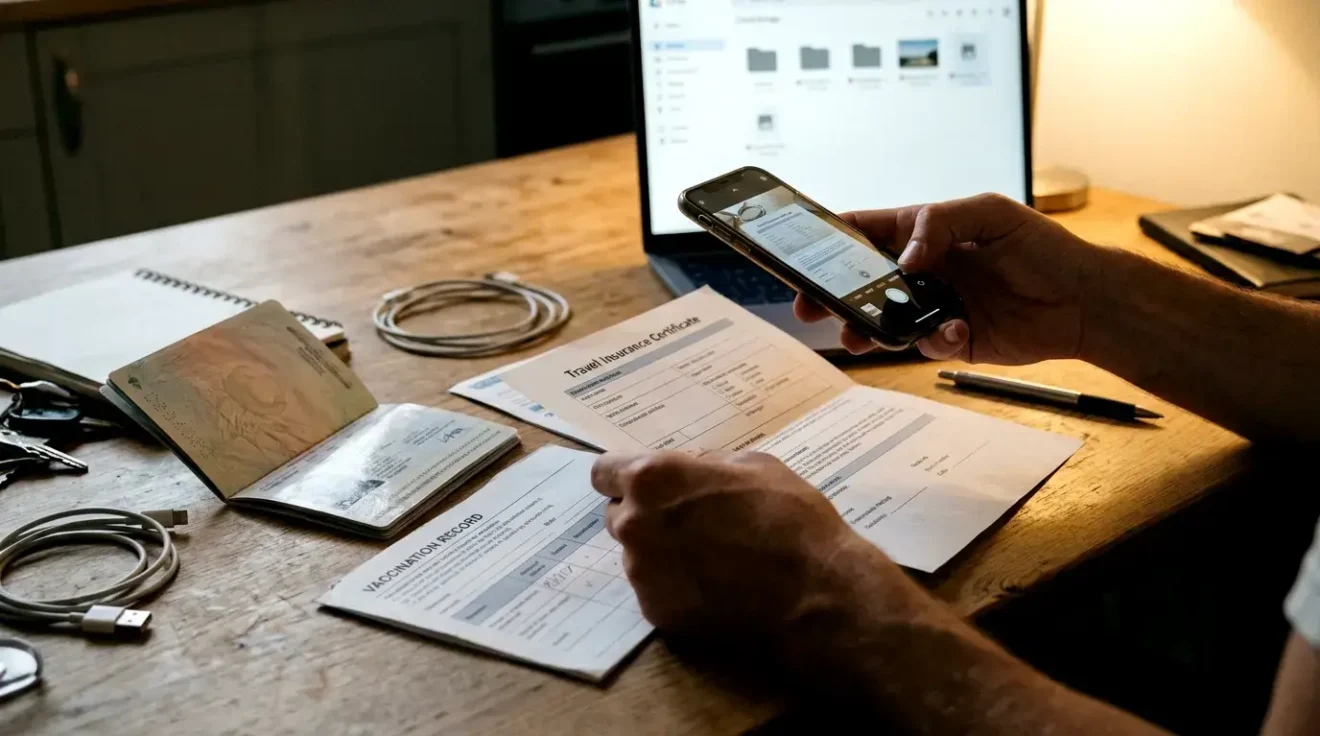
Different documents also require different handling. A scanned insurance certificate may help an insurer identify your policy, but whether a provider accepts it depends on its procedures. Similarly, a photographed passport can assist with replacement arrangements but is not ordinarily a substitute for a passport at international borders. Some destinations require original vaccination certificates, including yellow fever documentation when applicable.
Document preparation should begin well before the departure date. Passport renewals, visas and travel authorisations can have different processing periods, with delays depending on the issuing authority and individual circumstances.
A practical countdown starts when choosing the destination: check passport and visa requirements before making non-refundable commitments, submit applications with sufficient margin, and complete a final document inventory shortly before departure.
The FCDO foreign travel checklist recommends backup access to essential travel information, sharing important details with trusted contacts and checking destination requirements. Its guidance is directed primarily at British travellers, but the underlying document-management principles are widely useful.
Physical and digital separation also suggests a broader travel rule: never depend entirely on a single resource. This matters especially when choosing how to access money abroad.
Cash or Cards: What Should You Carry When Visiting Remote Regions?
Travellers visiting remote regions should generally carry a combination of local cash and independent payment cards, adjusted to the destination’s banking infrastructure and the time between reliable cash-access points. The appropriate balance depends on local card acceptance, ATM availability and the consequences of being unable to pay for essential transport, food or accommodation.
A remote destination is not necessarily cash-only. Some communities have functioning electronic payment systems but limited ATM access, while others depend primarily on cash. Research the payment options available at accommodation, transport providers and shops along your actual route rather than relying on information about the nearest major city.
Three questions help determine how much cash to carry:
- Infrastructure: can shops, accommodation providers and transport operators accept your cards or mobile payments?
- Distance between access points: how long might you travel without a functioning ATM or bank?
- Consequences of a payment failure: could insufficient funds prevent you from reaching accommodation, purchasing food or arranging onward transport?
When withdrawing money abroad, pay attention to dynamic currency conversion. Some ATMs offer to charge your account in your home currency rather than the local currency. That conversion can involve a different exchange rate and additional charges. Declining the offered conversion usually means the card network or issuer handles the conversion instead, but the final cost still depends on your card’s terms.
Withdrawal fees also deserve attention. If your bank charges a fixed amount per withdrawal, fewer, appropriately sized withdrawals may reduce those charges. However, large withdrawals increase the amount of cash exposed to loss or theft and may be restricted by daily withdrawal limits.

Small-denomination notes are particularly useful where vendors cannot provide change for large bills. Before leaving a town with banking facilities, consider exchanging some larger notes for smaller ones to cover short journeys and everyday purchases.
Cards create different risks. Banks may decline unusual overseas transactions through automated fraud-detection systems. Check whether your issuer recommends a travel notification, confirm international transactions are enabled and establish how you can contact the bank if a payment is blocked.
Carry at least two independent payment methods when possible, ideally issued through different accounts or providers. Store them separately, and keep emergency funds away from the wallet used for routine purchases.
A payment backup is most useful when you can reach your bank or retrieve the relevant information. Preparing the phone that supports those tasks is therefore equally important.
The Phone Settings to Check Before Travelling Outside Your Home Country
Before international travel, check data roaming, voice calling and text-message charges separately. Then confirm that your phone can use the intended SIM or eSIM, retain access to essential verification messages and function offline. Security settings, device tracking and battery management should also be reviewed so that the phone remains reliable throughout the journey.
Turning off data roaming does not necessarily prevent every international phone charge. Mobile data, outgoing calls, incoming calls and text messaging can be subject to different pricing arrangements. The charges depend on your provider, destination and tariff, including any roaming agreements that apply.
Review your mobile provider’s international rates and decide how you will connect:
| Option | Main advantage | Important limitation |
|---|---|---|
| Home-provider roaming package | Convenient setup and continued use of the existing number | Data allowances, geographic coverage and charges vary |
| Local physical SIM | Potentially suitable for longer visits or local services | May replace the home SIM unless the device supports multiple SIMs |
| Travel eSIM | Can often be installed before arrival without changing a physical SIM | Requires a compatible device; many travel plans provide data only |
Access to banking verification deserves particular attention. Some financial services send security codes to a registered mobile number. Switching entirely to a local SIM may leave you unable to receive those messages if your original number becomes inactive. Check the options offered by your bank and mobile provider before departure, including authenticator apps where supported.
Make the phone useful without internet access. Download offline maps covering the complete route, required translation language packs, boarding passes and accommodation details. Check whether each app actually allows access to its downloaded content without a connection.
For security, disable automatic joining of unfamiliar open Wi-Fi networks, enable device-finding and remote-lock functions, and protect the phone with a strong screen lock. Secure your account-recovery options and consider what you would do if the device were lost.
Finally, review power consumption. Background app refresh, frequent location updates and high screen brightness can shorten battery life. A compatible power bank and charging cable can help on long travel days, subject to airline rules on carrying batteries.
Even a correctly configured phone cannot guarantee coverage everywhere. The next precaution is to establish how you will communicate when the available internet connection is weak or unavailable.
How to Stay Connected Abroad When Public Wi-Fi Is Unreliable?
Reliable communication abroad requires a primary connection, a practical backup and essential information available offline. Mobile data or an eSIM can support navigation and messaging, while accommodation Wi-Fi may be suitable for less urgent tasks. The best arrangement depends on local coverage, the activities requiring internet access and the security of the network being used.
Start by matching connectivity needs to the service rather than searching for Wi-Fi indiscriminately. Sending a short message generally requires less bandwidth than uploading large files or joining a video call. Navigation can continue partly offline if maps have been downloaded, although live traffic and transport updates may be unavailable.
Different connections are therefore suitable for different situations:
- Mobile data: useful for directions, bookings and communication while moving, provided that the relevant network has coverage.
- Accommodation Wi-Fi: convenient for routine browsing and larger downloads when the connection is stable.
- Portable hotspot: potentially useful for connecting several devices, but still dependent on mobile coverage and the selected data plan.
- Public Wi-Fi: useful as a fallback, particularly for non-sensitive activities, with appropriate security precautions.
Public Wi-Fi presents risks that are not always visible. An open network may allow other parties to observe some network information, and a malicious hotspot can imitate a legitimate airport, hotel or café connection.
HTTPS protects the contents of encrypted web connections, while a trustworthy VPN can provide an additional encrypted tunnel between the device and the VPN provider. Neither measure makes an impersonated website safe, prevents every phishing attack or guarantees that a compromised device is secure.
Confirm the correct network name with the provider rather than connecting automatically to a familiar-looking signal. Avoid entering sensitive credentials into unexpected login pages and keep device software updated.
Check mobile network coverage for the specific areas of the itinerary, especially islands, mountain regions and rural roads. Carrier coverage maps can indicate likely availability but cannot guarantee signal strength inside buildings or across difficult terrain.
If reliable internet is essential, ask accommodation providers about connectivity before confirming a booking. Once you arrive, test the connection and identify an alternative, such as mobile data or another suitable location with internet access.
For critical coordination, keep an offline copy of pickup instructions, meeting addresses and reservation information. SMS may also provide a fallback where mobile service is available, but it should not be treated as guaranteed in areas without cellular coverage.
Connectivity improves access to urgent information, but knowing which information matters is just as important. Official travel advisories provide a starting point for understanding risks along the route.
How to Check Travel Advisories Before Visiting an Unfamiliar Region?
Check the official travel advisory issued by your home country’s government before booking an unfamiliar destination, then review the guidance for the specific regions you intend to visit. Pay attention to security warnings, local laws, health risks and recommended precautions. Recheck the information before departure and during the trip because conditions and official recommendations can change.
Government advisory systems commonly distinguish between ordinary precautions, heightened caution and recommendations against particular categories of travel. However, the terminology and classification systems differ by country, so levels from separate governments should not be treated as directly interchangeable.
Read beyond the country-wide headline. A destination may have specific warnings affecting border regions, neighbourhoods, roads or particular activities. A broad advisory might also include guidance on demonstrations, natural hazards, crime or transport disruption.
Travel advisories can affect financial decisions as well as personal safety. Insurance providers may restrict or exclude coverage for certain destinations, circumstances or activities, particularly where official authorities advise against travel. The exact consequences depend on the insurer, policy wording, applicable warning and timing of the trip.
Before paying for non-refundable arrangements, check whether the policy covers the intended destination and activities. Review cancellation conditions separately: an official warning does not automatically establish a right to a flight or hotel refund.
For a more complete assessment, compare three types of information:
- Official government advice covering the destination and the relevant regions.
- Recent local reporting describing developments that could affect the itinerary.
- Information from accommodation providers, transport operators or other credible local contacts about practical conditions.
Recent traveller reports can provide useful context, but individual experiences do not override official warnings. Personal impressions may also overlook risks that are uncommon but serious.
During the trip, use available government email alerts, embassy notifications or traveller registration programmes. Not every government offers the same services, and registration does not guarantee emergency assistance. Keep contact information for relevant consular services and local emergency providers accessible offline.
A useful monitoring habit is to review advisories before moving into a different region or beginning an activity that could be affected by changing conditions.
Once safety and entry conditions have been assessed, smaller local procedures also deserve attention. Urban transport payment systems are a common source of unexpected charges and confusion.
The Contactless Payment Mistakes Tourists Make on Urban Transport
Tourists can incur unnecessary transport charges by using different cards or devices for connected journeys, failing to complete required taps or assuming every contactless system follows the same rules. In networks offering fare capping, consistent use of the same payment method can matter. Travellers should verify the local operator’s payment rules before their first journey.
Fare capping means that eligible pay-as-you-go journeys are charged subject to a specified daily or weekly limit. The calculation depends on the particular network, ticket type and journey conditions.
London provides a useful documented example. According to TfL’s official fare-capping rules, eligible contactless and Oyster journeys can benefit from daily and weekly caps when the passenger uses the same payment card or device consistently.
04:30–04:29
London’s daily pay-as-you-go fare-cap period runs from 04:30 until 04:29 the following day. The weekly cap follows a fixed Monday-to-Sunday period. These are Transport for London rules, not universal arrangements for contactless transport.
Transport for London, official fare-capping guidance.
A common mistake is assuming that tapping a physical bank card and tapping the same card through a phone wallet count as identical payment methods. In London’s system, they are treated as separate payment devices for fare calculations. Alternating between them can divide journey records and prevent the intended cap from being applied across all trips.
Another issue is card clash. Presenting a wallet containing several contactless cards, or holding a phone and card together near a reader, may cause the system to detect an unintended payment method. Take out the chosen card or device and use it alone.
Some networks require passengers to tap both when entering and leaving, while others use different validation procedures. In London, an incomplete journey on services requiring touch-in and touch-out can produce a maximum fare rather than the correct journey fare.
These rules should not be assumed to apply identically in other cities. Before travelling, establish whether the local transport operator accepts your particular card, whether contactless use is available on the intended routes and whether registration is necessary to review transactions.
International cards may also incur issuer foreign-transaction charges. Those costs are separate from the transport operator’s fare calculation.
After the first day, review your journey history where available and compare it with your bank’s transaction records. Some systems post charges later or combine journeys into a single settlement, so a pending entry is not necessarily a final fare or duplicate charge.
Local payment routines become easier with experience. Allowing sufficient time to learn them is another reason not to overload the itinerary with attractions and transfers.
Key takeaways before planning your days
- Prioritise commitments that cannot easily be changed, including international flights, essential transfers and limited-availability reservations.
- Treat recovery time as part of the itinerary, particularly after long journeys and before demanding activities.
- Choose fewer destinations when additional transfers would leave little opportunity to experience each place properly.
How to Plan a Balanced Trip With Enough Sightseeing and Time to Relax?
Plan a balanced international holiday around available energy rather than the maximum number of attractions. Choose one main activity for most sightseeing days, allow time for meals and local transport, and protect recovery periods around long journeys. Reserve experiences that genuinely require advance booking while keeping less essential activities flexible.
International travel can be tiring even when everything runs according to schedule. Long flights, unfamiliar transport systems, changing time zones and disrupted sleep can reduce the energy available for sightseeing.
Instead of scheduling several major attractions immediately after arrival, consider using the first day for accommodation check-in, a short walk, a meal and essential practical tasks. The appropriate pace depends on arrival time, travel duration and how the individual traveller feels.
One anchor activity per day provides a useful starting point. An anchor might be a museum, an organised excursion or a major historical site. Smaller activities can then fit around it without turning the entire day into a series of deadlines.
For example, a hypothetical day in an unfamiliar city might involve a reserved morning museum visit, lunch in the surrounding neighbourhood and an optional afternoon walk. If travel delays or fatigue interfere, the flexible portion can be shortened without affecting the main reservation.
Build buffers around transport days and demanding activities. Unscheduled time can accommodate delayed trains, unexpected weather, minor illness or simply the need to rest. It is not wasted time; it reduces the number of commitments affected when one part of the itinerary changes.
The number of destinations also influences stress. Each additional stop introduces packing, transfers, check-in procedures and time spent learning a new environment. Before adding another city, consider whether it will receive at least one full day that is not dominated by arrival or departure arrangements.
This is a planning guideline rather than a universal minimum. A short stopover can be worthwhile for a specific purpose, but travellers should compare the expected experience with the practical costs of reaching and leaving the destination.
Advance reservations should focus on genuinely constrained activities: timed-entry attractions, limited-capacity tours and experiences that are difficult to arrange at short notice. Everyday meals, neighbourhood exploration and many outdoor activities can often remain open to spontaneous decisions, depending on the destination.
Leave room for weather changes and local discoveries. An itinerary should provide enough structure to make important activities possible without requiring every hour to unfold exactly as planned.
Before booking the remaining activities, review the schedule and remove any unnecessary transfer or tightly timed commitment. Keep the essential reservations, protect genuine downtime and save the final itinerary offline. The aim is not to eliminate uncertainty but to make ordinary travel disruptions manageable.
How early should I start preparing for my first international holiday?
Begin checking entry requirements as soon as you choose a destination, preferably before making non-refundable bookings. Passport renewal and visa processing times vary by nationality, destination and application circumstances. Prepare insurance, payment arrangements and connectivity before departure, then complete a final document check shortly before travelling.
What should I do if my passport is lost while travelling abroad?
Contact the nearest embassy or consulate representing your nationality and follow its instructions for obtaining replacement or emergency travel documentation. Depending on local circumstances, a police report may also be required or useful. Secure digital copies and contact details can help establish your identity, but they do not replace an official travel document.
Can I travel internationally without a credit card?
Many journeys are possible without a credit card, but acceptance depends on the destination and service provider. Some hotels and vehicle rental companies require a qualifying payment card or deposit. Check these conditions before booking and arrange independent access to funds, such as an accepted debit card and an appropriate cash reserve.
What should I do if my phone stops working after arriving abroad?
First check whether the problem involves the device, mobile network, SIM configuration or an exhausted data allowance. Use previously downloaded travel information and a trusted alternative connection if available. Contact your mobile provider through an appropriate channel, and keep accommodation addresses and essential contact numbers accessible independently of the phone.
Is travel insurance necessary for a short international holiday?
Travel insurance is strongly worth considering even for short trips, and some destinations require particular insurance coverage for entry. Medical treatment, emergency transport, cancellation and lost-property provisions vary between policies. Review geographical limits, exclusions, activities covered and any restrictions connected to official travel advisories before purchasing.