Accessible outdoor adventures combine manageable physical demands, predictable conditions and enough support to help newcomers respond confidently when something unexpected happens. Gentle woodland hikes, guided kayaking in sheltered bays, introductory zipline courses and easy-grade rafting can all provide memorable experiences without requiring advanced outdoor skills.
The right choice depends less on how exciting an activity looks than on your fitness, comfort with heights or water, environmental conditions and the quality of supervision available. A short mountain trail can be surprisingly exhausting, while a carefully managed rafting excursion may feel more approachable than its reputation suggests.
For holidaymakers exploring unfamiliar destinations, preparation should begin with practical questions: How difficult is the route really? What happens if the weather changes? Can you withdraw without putting yourself or others at risk? Understanding these details makes it possible to pursue adventure progressively rather than choosing between unnecessary danger and avoiding outdoor activities altogether.
Choosing a beginner-friendly outdoor adventure
- Match the activity to your abilities: assess terrain, endurance, swimming confidence and tolerance for heights before considering advertised difficulty labels.
- Evaluate environmental conditions: check local marine forecasts, elevation profiles, heat exposure and official hazard warnings.
- Start with controlled experiences: favour shorter routes, sheltered environments and operators with clear safety procedures and realistic cancellation policies.
- Why Does Mountain Terrain Make Short Hikes Harder Than Expected?
- How to Prepare for Your First Sea Kayaking Trip in Coastal Waters?
- Ziplining or Rafting: Which Adventure Is Better for Nervous Beginners?
- The Hydration Mistake That Makes Summer Excursions Dangerous
- When Is the Safest Time of Day for Outdoor Adventures in Hot Climates?
- The Experience-Level Labels to Question Before Booking an Adventure Tour
- When Should You Reconsider a Trip After a Natural Disaster Warning?
- Which Type of Experience Suits Your First Independent Adventure Abroad?
Why Does Mountain Terrain Make Short Hikes Harder Than Expected?
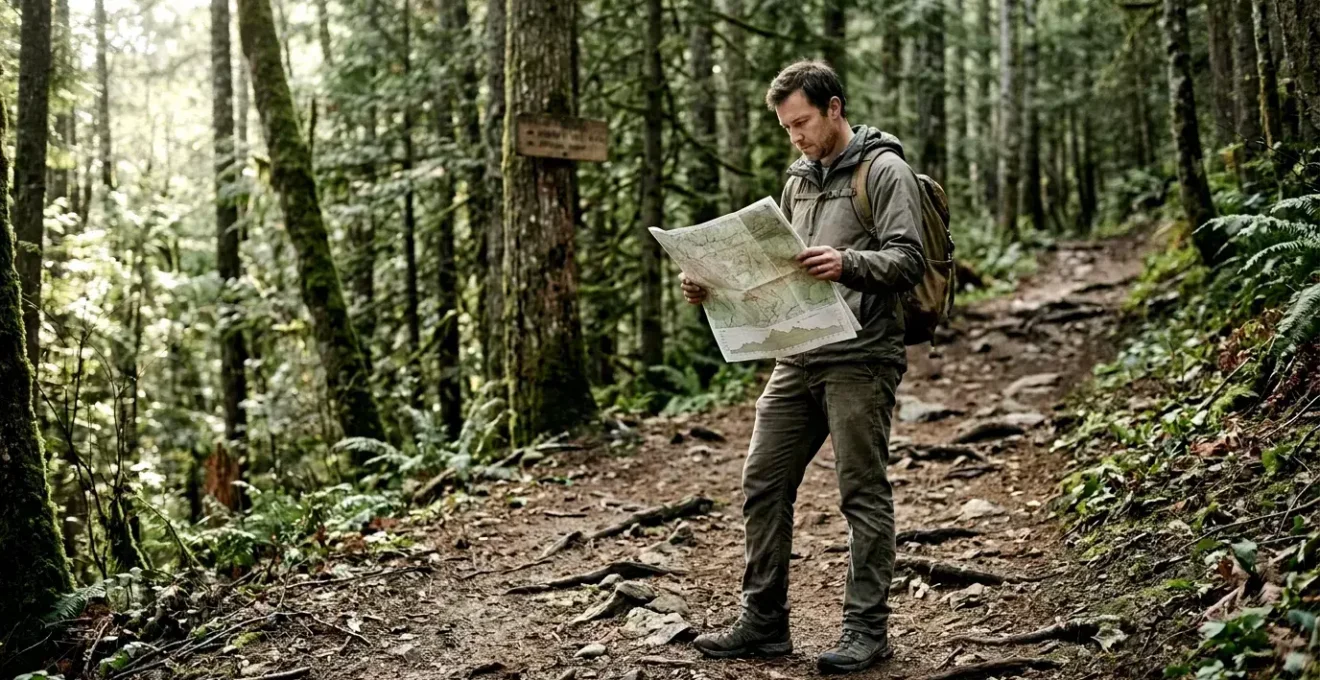
Mountain hikes can be considerably harder than their distance suggests because elevation gain, uneven surfaces and sustained gradients increase physical effort. A short route involving steep climbs, loose stones or exposed sections may demand more stamina and concentration than a much longer walk on level ground. Beginners should assess elevation profiles and trail conditions alongside kilometres.
Walking uphill requires additional muscular and cardiovascular effort, while descending over unstable ground places different demands on balance and leg muscles. Roots, rocks and irregular steps can also slow progress because every foot placement requires attention. These factors explain why a five-kilometre mountain hike could feel more demanding than a fifteen-kilometre walk across flat terrain, although the comparison depends on the actual routes and individual fitness.
A useful planning reference is Naismith’s rule, which estimates walking time by combining horizontal distance with accumulated ascent. Its commonly used starting assumption is approximately one hour per five kilometres, plus one hour per 600 metres of ascent. This is a traditional planning heuristic, not a reliable prediction for every walker. Difficult descents, poor footing, rest stops, weather and personal fitness require additional allowances.
Consider a hypothetical five-kilometre route with 600 metres of ascent. The basic rule suggests approximately two hours before accounting for breaks and terrain complications. That estimate is useful for recognising the route’s demands, not for promising a completion time.
Trail descriptions also deserve careful interpretation. Terms such as “moderate”, “undulating” and “steep in sections” may conceal substantial differences between routes. A technically straightforward path can still require sustained endurance.
The ISO 3021:2023 standard for adventure tourism hiking and trekking establishes requirements and recommendations concerning participant safety and route difficulty classification. Its existence does not mean every tourism operator applies the same criteria.
Before accepting a promotional description, compare it with a topographic map, elevation profile, recent trail conditions and independent accounts from walkers with similar experience. Pay particular attention to cumulative ascent, exposed sections, escape routes and whether the path becomes difficult in wet weather.
For an initial independent hike, a forest trail or valley route with gradual elevation changes and straightforward navigation generally offers more flexibility than a steep mountain ascent.
The aim is not to avoid mountain scenery permanently. Building confidence on progressively more demanding terrain provides a practical foundation for other activities where environmental conditions matter just as much as physical ability.
How to Prepare for Your First Sea Kayaking Trip in Coastal Waters?
Your first sea kayaking trip should take place in sheltered coastal waters with suitable supervision, correctly fitted safety equipment and favourable marine conditions. Before booking, check local forecasts for wind, waves, swell, tides and currents. Choose an operator who explains the route, assesses participants’ abilities and has clear procedures for weather changes or emergencies.
Sea kayaking differs from paddling on a calm inland lake because coastal conditions can change within a short distance. Tidal currents may accelerate through narrow channels or estuaries, while offshore winds can make returning to land unexpectedly difficult.
General weather applications rarely provide everything needed for a coastal decision. Consult the destination’s official marine forecast, local tide predictions and relevant navigational or weather warnings. Examine conditions for the entire planned outing, not simply the departure time.
The Australian Bureau of Meteorology‘s water sports safety guidance recommends that novice paddlers limit themselves to waves below 0.5 metres. This is Australian guidance rather than a universal safety threshold, and smaller waves do not automatically make an outing safe.
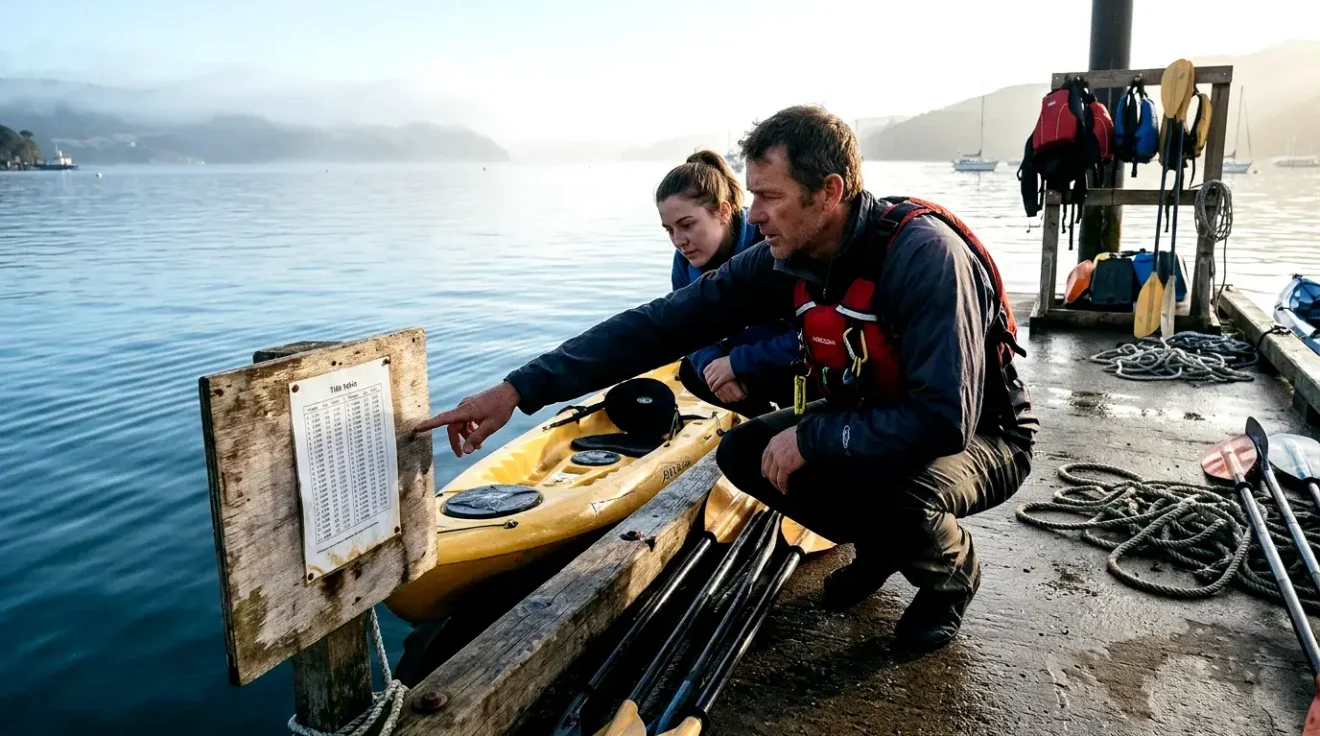
For a first outing, favour a protected bay, a short route close to suitable landing locations and a guided group. Ask about the guide’s relevant qualifications, local experience, group size, communication equipment and procedures for assisting a tired or capsized participant.
A properly fitted personal flotation device is essential. Beginners should also learn basic forward strokes, turning and stopping techniques, and practise capsize recovery or assisted rescue in controlled conditions under qualified supervision. The appropriate training depends on the kayak type and operating environment.
Dress for the water temperature, not just the air temperature. Cold-water immersion can rapidly impair movement and increase the risk of hypothermia even on an otherwise warm day. Ask whether the operator supplies appropriate immersion protection and how it decides when conditions require cancellation.
A well-managed introductory paddle should leave participants comfortable practising new skills rather than struggling against wind or current. Once that foundation is established, longer coastal routes can become realistic options.
Ziplining or Rafting: Which Adventure Is Better for Nervous Beginners?
Ziplining may suit beginners who can tolerate a brief fear of heights and prefer limited physical involvement, while gentle rafting may appeal to those who feel more comfortable acting alongside a group. Neither activity is automatically safer. The better choice depends on the specific course or river, individual fears, swimming confidence and the operator’s safety arrangements.
The distinction is psychological as well as physical. During ziplining, participants typically rely on installed equipment, correctly fitted harnesses and established operating procedures. Once a descent begins, their ability to influence its outcome may be limited.
Rafting involves continuous movement and active participation. Even on an easy river, paddlers must follow instructions, maintain position and respond together as conditions change. That engagement can reassure some people while increasing anxiety for others.
The comparison becomes clearer when focusing on how each activity feels in practice.
| Decision factor | Ziplining | Rafting |
|---|---|---|
| Typical concern | Height, exposure and leaving the platform | Moving water, instability and possible immersion |
| Participant involvement | Usually limited during each descent | Active paddling and teamwork |
| Physical effort | Often modest, but access routes and platforms may require exertion | Varies with river conditions, duration and paddling demands |
| Beginner format | Short, lower-height introductory course | Guided excursion on suitable easy-grade water |
| Important checks | Equipment inspection, rescue procedures and eligibility limits | River grade, water conditions, guide competence and rescue equipment |
River grading offers a useful starting point. In widely used whitewater classifications, Class I generally describes easy-moving water with limited obstacles, while Class II introduces straightforward rapids that require greater attention. Higher classes involve progressively more difficult conditions, with Class VI associated with exceptionally hazardous rapids. The exact classification system and its application should be checked locally.
River grade alone does not determine suitability: high water levels, cold temperatures, obstacles and limited rescue access can change the risk substantially.
For ziplining, ask about the course’s height and length, relevant inspection and operating standards, participant weight and age limits, supervision, and evacuation arrangements. For rafting, verify guide qualifications, group-to-guide arrangements, personal flotation devices, helmets where appropriate and procedures for a participant falling into the water.
A useful compromise is to try a reduced-intensity version first: a lower zipline with a supervised practice element, or a short guided rafting trip on easy water. Avoid operators who pressure anxious guests into continuing.
Comfort is a legitimate selection criterion. An activity that permits curiosity, attention and gradual confidence-building is usually a better introduction than one dominated by distress, even when its technical requirements are modest.
The Hydration Mistake That Makes Summer Excursions Dangerous
One preventable mistake on summer excursions is starting without enough water and relying on thirst to determine when to drink. During sustained activity in hot conditions, this can delay fluid replacement and make fatigue or heat-related illness more likely. Beginners should plan their water supply before departure, drink regularly and adjust their approach to exertion and environmental conditions.
Heat increases the body’s need to regulate temperature through sweating, while physical activity adds further demands. Travellers absorbed in navigating a trail, paddling or keeping up with a group may overlook the opportunity to drink.
The CDC guidance on exercise and heat exposure recommends drinking more water than usual during hot-weather exercise rather than waiting until thirst develops. It also advises stopping activity and moving somewhere cool when feeling faint or weak.
However, hydration planning is not simply a matter of drinking the largest possible amount. Needs vary with exertion, body size, acclimatisation, clothing, temperature and humidity. No single hourly volume fits every outdoor activity or participant.
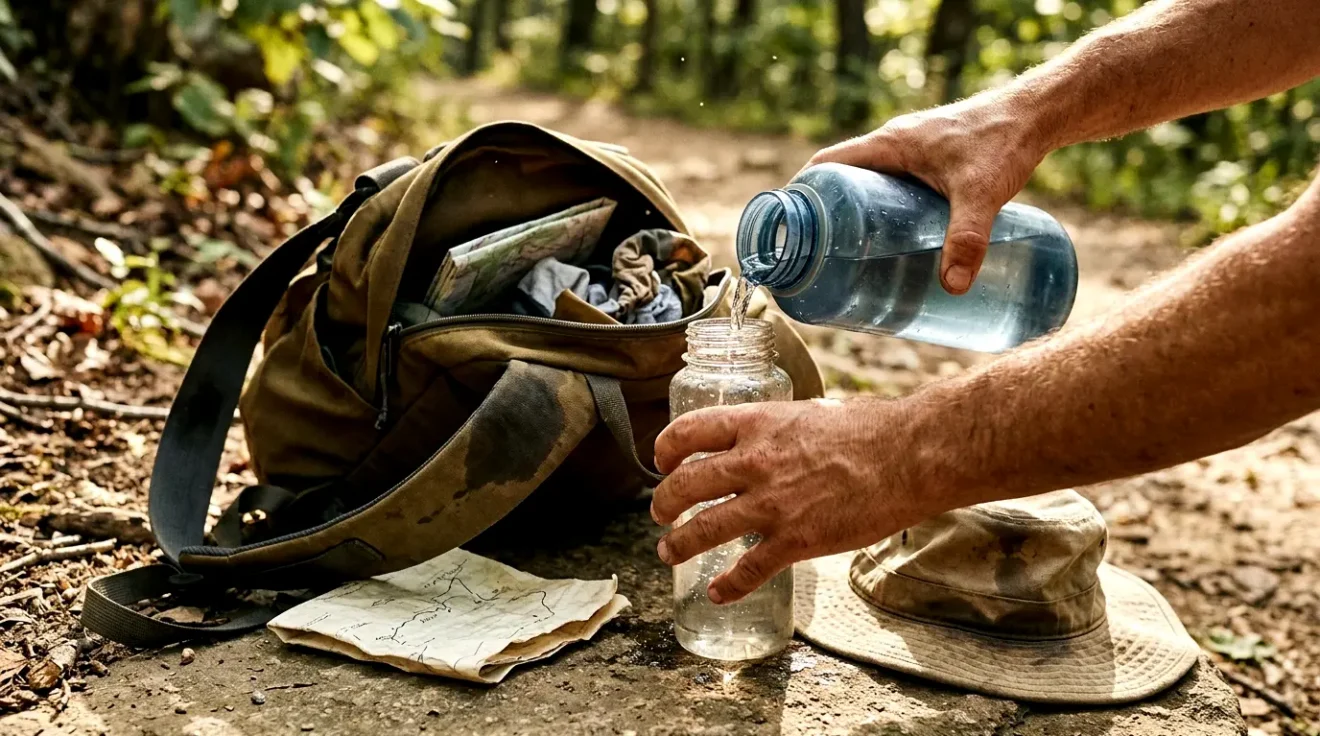
Estimate the planned duration, expected intensity, heat exposure and opportunities to replenish water. Confirm whether refill points actually operate during your visit and whether the water is safe to drink. Carry an appropriate reserve rather than assuming shops or fountains will be available.
Long periods of heavy sweating also create electrolyte losses. Conversely, excessive water consumption, particularly when it exceeds the body’s ability to eliminate water, can cause dangerous dilution of blood sodium. Electrolyte replacement may be appropriate during prolonged sweaty activity, but it does not make unlimited water intake safe.
Headache, nausea, confusion, marked weakness and unusual dizziness warrant attention because they can accompany serious heat-related or fluid-balance problems. Stop exertion, seek assistance and obtain urgent medical evaluation for severe symptoms. Consult a healthcare professional for personalised advice when medical conditions or medications affect fluid needs.
Hydration logistics should influence which activity you book. Carrying accessible water is straightforward on many walks but may be harder during ziplining, canyoning, via ferrata or kayaking, where equipment and operating procedures restrict access.
A route with regular shade, accessible water and opportunities to shorten the outing may be a better beginner choice than a demanding excursion where drinking is difficult. The timing of the activity provides another important layer of protection.
When Is the Safest Time of Day for Outdoor Adventures in Hot Climates?
Early morning is often the more suitable time for physically demanding outdoor adventures in hot climates because temperatures and sun exposure are generally lower than around midday. Late afternoon or evening may also provide cooler conditions, but humidity, retained ground heat and developing thunderstorms can change the risk. The safest period depends on local forecasts and activity duration.
There is no universal departure hour that guarantees safety. Temperature, solar radiation, humidity, wind and shade interact differently across seasons and destinations. In some environments, air temperatures remain high well into the evening, even after direct sunlight weakens.
For hiking, climbing approaches and via ferrata, an early departure can reduce exposure to intense sunlight and help avoid completing the most demanding section during peak heat. It is still necessary to allow sufficient daylight for the return.
Guided sunset kayaking may be suitable in sheltered waters under favourable conditions, provided the operator accounts for changing winds, visibility, tides and safe landing arrangements. Cooler air does not remove the dangers of cold water or an offshore breeze.
Rather than checking temperature alone, review the following conditions:
- Heat and humidity: high humidity or a high dew point can make evaporative cooling less effective.
- Duration: consider whether the entire outing, including the return, overlaps the hottest part of the day.
- Shade: open ridges, exposed rock and unshaded tracks offer limited protection from solar radiation.
- Storm potential: forecast thunderstorms can make exposed terrain and open water unsuitable.
- Recovery options: assess access to drinking water, cooler locations and routes that can be shortened.
In tropical destinations, afternoon thunderstorms may develop regularly during certain seasons. Starting earlier can therefore reduce storm exposure as well as heat exposure, although the actual forecast must determine whether the outing is appropriate.
Where available, consult local heat-risk indicators and official weather alerts. Heat index, wet-bulb-related measures and local occupational or recreational heat guidance can provide additional context, but none replaces activity-specific judgement.
When severe heat or thunderstorms are forecast, rescheduling or cancelling may be more appropriate than simply shifting the starting time.
Even a carefully chosen morning excursion can become unsuitable if conditions deteriorate. This is why tour difficulty ratings and operator decisions must be evaluated independently of the advertised schedule.
The Experience-Level Labels to Question Before Booking an Adventure Tour
Tour labels such as “beginner-friendly”, “easy”, “family adventure” and “moderate” should be treated as starting points rather than guarantees of suitability. Their interpretation can vary between operators, countries and booking platforms. A reliable booking decision requires measurable route details, realistic physical requirements and clear information about supervision, hazards and withdrawal options.
One common misunderstanding is equating technical simplicity with low physical effort. A guided trail may require no specialist climbing skills yet involve several hours of continuous ascent. Similarly, a rafting trip may demand little previous experience while still requiring sustained paddling and comfort in moving water.
Some activities have published technical classifications or internationally recognised standards, but these do not create a single universal meaning for every marketing label.
To evaluate a listing, identify the measurable demands behind its description. Hiking listings should specify distance, elevation, terrain and estimated duration. Water-based experiences should identify the operating environment and relevant river or marine conditions. Zipline courses should explain physical eligibility requirements and the nature of the route.
Read recent reviews from travellers who openly identify as first-timers. Reports that an excursion was “harder than expected” are especially useful when they describe specific problems, such as steep climbs, tiring approaches or limited preparation time. A positive overall rating does not necessarily demonstrate suitability for your own ability.
Before making a reservation, complete this practical assessment.
Five checks to complete before booking a beginner adventure
- Record the actual demands: create a short note listing route length, elevation, duration, technical grade or relevant equipment requirements.
- Verify the environment: save the applicable terrain information or official local forecast and identify conditions that would make the outing unsuitable.
- Check the operator: obtain written confirmation of relevant guide qualifications, safety equipment, group supervision and emergency arrangements.
- Clarify flexibility: record the operator’s answers about withdrawing during the activity, weather cancellations and refund or rescheduling terms.
- Compare with your abilities: write down your realistic endurance, relevant experience and concerns, then confirm whether the operator considers the activity appropriate.
Warning signs include vague descriptions, no meaningful information about physical demands, unanswered safety questions and unclear weather cancellation procedures. An operator unwilling to explain how beginners are supervised deserves additional scrutiny.
Ask what proportion of recent participants had no previous experience, whether a preparatory session is provided and what happens if someone decides not to continue. These answers may be more informative than an attractive difficulty badge.
A trustworthy activity description should help visitors make informed decisions, including choosing a different tour. That clarity becomes particularly important when unexpected weather or natural hazards threaten an itinerary.
When Should You Reconsider a Trip After a Natural Disaster Warning?
Reconsider an outdoor adventure whenever an official hazard warning affects the activity area, access routes or planned travel period, especially if authorities recommend avoiding travel or require evacuation. Do not depend solely on the organiser’s willingness to proceed. Check the destination’s official alerts, confirm whether infrastructure remains accessible and follow all applicable local emergency instructions.
Weather information and emergency warnings do not always indicate the same level of risk. A routine forecast may identify uncertain conditions, while an official severe-weather warning can signal a specific threat requiring immediate changes. Evacuation orders are more serious and must be followed.
Warning terminology and colour systems vary between countries. Consult the national meteorological service, relevant emergency management authority and local government responsible for the area concerned. Advice from your home country’s travel authorities can supplement, but not override, local emergency instructions.
A practical decision involves three questions:
- Is the location affected? Check the precise activity area, access roads and surrounding terrain, not just the destination city.
- Does the warning overlap the outing? Review its validity period and any residual hazards that could persist after the immediate event.
- What is the required response? Confirm local instructions and the operator’s cancellation or emergency arrangements. Do not proceed if official restrictions or unsafe conditions make the activity unsuitable.
These questions help interpret warnings, but they are not a substitute for complying with official instructions. A warning outside the exact activity window may still matter if flooding, landslides or damaged infrastructure remain possible.
The UK Foreign, Commonwealth & Development Office‘s guidance on extreme weather and natural hazards abroad advises travellers to follow local authorities, including evacuation orders, and investigate local warning systems before visiting exposed regions.
Natural disasters can affect more than the adventure itself. Roads, bridges, communications, accommodation and medical facilities may become unavailable. A trail might remain closed even after the surrounding weather improves.
Before departure, review insurance coverage and the contractual conditions of flights, accommodation and tour bookings. Coverage for cancellation, natural disasters and disrupted activities depends on the policy and booking terms; refunds should never be assumed.
International travellers should also identify the local emergency number, suitable official warning services and any relevant embassy or consular registration options. Share essential itinerary details with a trusted contact.
Changing an itinerary in response to credible information is a normal part of outdoor decision-making. The ability to recognise when conditions exceed your experience is essential before progressing towards greater independence abroad.
Key takeaways before choosing your first adventure abroad
- Choose an experience format that matches your navigation, communication and decision-making abilities, not simply your appetite for excitement.
- Prioritise reliable local information, accessible assistance and flexibility over a destination’s visual appeal.
- Build independence progressively: mastering preparation and recognising your limits matter more than completing an ambitious itinerary.
Which Type of Experience Suits Your First Independent Adventure Abroad?
For a first adventure abroad, a guided group excursion or hybrid trip with organised accommodation and independently chosen activities usually provides a manageable balance of freedom and support. A fully independent route is better suited to beginners who already have basic navigation skills, realistic endurance awareness and confidence interpreting local conditions. The ideal format depends on preparation, not destination prestige.
There are three practical ways to structure a first nature-based adventure overseas, each offering a different combination of freedom, responsibility and logistical demands.
| Experience format | Suitable beginner profile | Main trade-off |
|---|---|---|
| Guided group adventure | Travellers unfamiliar with the environment, activity or local language | More supervision and shared logistics, but less flexibility |
| Independent marked route | Travellers comfortable navigating, assessing conditions and managing basic unexpected situations | Greater autonomy, but greater responsibility for planning and decisions |
| Hybrid organised stay | Travellers seeking flexible activities with some accommodation or transport arrangements already handled | Reduced logistical burden, although self-directed outings still require safety preparation |
Guided activities can be particularly useful for sea kayaking, rafting and other experiences where local environmental knowledge or specialised equipment matters. They also allow beginners to observe how qualified leaders assess changing conditions.
Independently following a clearly marked woodland or coastal route may be appropriate for travellers who can read maps, check weather conditions and recognise when to turn back. However, marked paths are not necessarily easy, regularly maintained or accessible to emergency responders.
Hybrid arrangements offer another progression. Accommodation, local transport or selected guided activities can be organised in advance, leaving room for independently planned walks and simpler outdoor experiences. Costs vary by destination and provider, so the most economical format cannot be assumed without comparing actual inclusions.
Before choosing, evaluate five personal factors: current fitness, navigation ability, comfort communicating locally, tolerance for unexpected changes and willingness to organise equipment and transport.
Environmental conditions should then determine whether the proposed format remains appropriate. High altitude, extreme heat, remote terrain, strong coastal currents or limited medical access can make an otherwise attractive destination unsuitable for a first independent outing.
A sensible progression might begin with a guided coastal paddle, continue with a self-directed walk on well-maintained terrain and eventually expand to more complex itineraries as practical skills improve. Each new experience should introduce manageable challenges without combining several unfamiliar hazards at once.
Choose one realistic outdoor activity for your next holiday, obtain its measurable difficulty details and check the expected environmental conditions against your abilities. If the uncertainties are manageable, book the appropriate format; if they are not, shorten the route, add qualified supervision or select a more sheltered alternative. Adventure becomes more rewarding when independence grows alongside sound judgement.
Can someone with little fitness experience still enjoy an outdoor adventure?
Yes, provided the activity’s physical requirements match their current abilities. Short walks on gentle terrain and introductory supervised activities may be suitable starting points. Check walking distance, terrain, rest opportunities and any minimum fitness requirements. Start with manageable durations and avoid treating an advertised beginner label as proof that no physical preparation is necessary.
Is swimming ability necessary for beginner water adventures?
Swimming requirements depend on the activity, conditions and operator. Some introductory experiences may accommodate participants with limited swimming ability, while others require specific water competence. A personal flotation device does not replace swimming skills, rescue preparation or suitable supervision. Inform the operator about your actual swimming confidence before booking and follow its eligibility requirements.
What should a beginner do if outdoor conditions change unexpectedly?
Stop and reassess the situation before continuing. On land, consider returning along a known safe route or reaching a designated shelter if conditions permit. During guided activities, follow the leader’s emergency instructions. Avoid exposed locations during thunderstorms and never enter dangerous water to escape other hazards. If immediate danger develops, follow official emergency guidance and request assistance using the local emergency service.
Should beginners buy specialist equipment before their first adventure?
Not necessarily. Reputable guided operators may supply activity-specific safety equipment such as helmets, harnesses or personal flotation devices. Confirm what is included, how equipment is fitted and which personal items you must bring. Appropriate footwear, clothing, sun protection and drinking water may be more immediately useful for a simple hiking excursion than expensive specialised gear.
How can beginners recognise when an adventure is too ambitious?
An excursion may be too ambitious when its duration, physical demands, environmental exposure or required skills exceed what you can realistically manage. Difficulty descriptions that remain vague after questioning, limited opportunities to withdraw and unsuitable forecasts are additional reasons to reconsider. Choosing a shorter route or additional supervision is a practical adjustment, not a failure to pursue adventure.