
Two regions within the same country can produce remarkably different holidays. One might offer comfortable temperatures, frequent buses and lively village squares. Another, despite having equally attractive scenery, may involve steep streets, limited services and long journeys between attractions.
Before choosing a region, research its local climate, geography, transport connections, tourist facilities, accessibility, seasonal opening hours and everyday atmosphere. These characteristics determine not only what travellers can see but also how comfortably and independently they can experience a destination.
The important question is not simply whether a region is beautiful or popular. It is whether its practical conditions match the traveller’s budget, interests, mobility requirements and preferred pace.
Comparing these characteristics at town level, rather than relying on country-wide descriptions, can reveal important differences before accommodation is booked. A few carefully selected checks can distinguish an appealing destination from a genuinely suitable holiday base.
Regional characteristics worth checking first
- Climate and geography: Compare local temperature patterns, rainfall, elevation and coastal exposure for the actual travel month.
- Transport and essential services: Verify return connections, accommodation locations, food options and seasonal availability before choosing a base.
- Accessibility and local routines: Examine walking conditions, opening hours and daily rhythms to determine whether the region suits your preferred travel style.
- Which Travel Destinations Suit Your Budget, Interests, and Travel Style?
- Why Can Coastal and Inland Towns Have Very Different Holiday Weather?
- Why Can the Same Month Bring Opposite Weather Across Southeast Asia?
- Northern or Southern Italy: Which Better Suits a Slow-Paced Holiday?
- How to Assess Tourist Facilities in Remote Mountain Villages?
- How to Plan Village-to-Village Day Trips Using Regional Transport?
- How Do Local Business Hours Affect Sightseeing in Small Mediterranean Towns?
- Why Picturesque Old Towns Can Be Difficult for Travellers With Limited Mobility
Which Travel Destinations Suit Your Budget, Interests, and Travel Style?
The most suitable travel destination is a region where everyday costs, available activities and the pace of daily life match your priorities. A coastal resort may suit someone seeking convenient relaxation, while a rural valley may appeal to independent walkers. Neither is automatically better: the right choice depends on how you want to spend an ordinary holiday day.
Start by defining three variables: your affordable daily expenditure, your main reason for travelling and how much activity you enjoy. Consider your budget after accounting for accommodation and transport, rather than comparing room prices alone.
The following grid is a qualitative starting point, not a statement about actual prices in particular regions.
| Traveller profile | Regional characteristics to prioritise | Potential trade-off |
|---|---|---|
| Cost-conscious, interested in local culture, relaxed pace | Small towns with essential shops, accessible public transport and accommodation outside major visitor centres | Fewer evening activities or less frequent transport |
| Comfort-focused, interested in beaches and restaurants | Coastal towns with nearby services, accessible waterfronts and varied dining | Higher seasonal demand and potentially greater costs |
| Outdoor-focused, independent and active | Mountain valleys or countryside with established trails and transport or parking access | Greater dependence on weather and seasonal facilities |
| Culture-focused, interested in frequent sightseeing | Well-connected historic towns or regional transport hubs | Busier central areas and less secluded surroundings |
Independent travellers should give particular weight to transport autonomy, food supplies and flexible access to activities. Travellers following structured itineraries may value proximity to meeting points, organised excursions and accommodation services more highly.
A region’s reputation is not a reliable compatibility test. A celebrated wine-producing area might disappoint someone who prefers wilderness walks; an acclaimed hiking destination may be frustrating for someone seeking museums and evening entertainment.
Try a simple exercise: write down three activities you would genuinely enjoy during a typical day, then check whether the candidate region supports at least two without excessive travel or additional expense.
For example, a hypothetical traveller who enjoys markets, short walks and leisurely café visits should investigate walkable towns with accessible countryside rather than automatically choosing the area’s most remote and scenic accommodation.
Once a suitable regional profile is clear, the next question is whether local conditions will support those activities during the intended travel period. Weather is often the first major difference to investigate.
Why Can Coastal and Inland Towns Have Very Different Holiday Weather?
Coastal and inland towns can experience different holiday weather because nearby seas moderate temperature changes, while inland surfaces heat and cool more rapidly. Sea breezes, elevation, terrain and wind exposure also influence local conditions. Consequently, two towns within the same region can have noticeably different afternoon temperatures, evening comfort and rainfall patterns.
Water generally warms and cools more slowly than land. During suitable weather conditions, cooler maritime air may move inland as a sea breeze, moderating daytime heat near the shoreline. Coastal locations may also retain relatively mild temperatures overnight, while inland areas can experience greater day-to-night variation.
This distinction is measurable in some regions. Malaysia’s meteorological authority reports daily temperature ranges of 5–10 °C at coastal stations and 8–12°C at inland stations. These observations describe Malaysian conditions and should not be applied numerically to every destination.

To investigate these differences, compare historical monthly temperature and rainfall data for two actual towns rather than relying on a regional forecast. NOAA‘s 1991–2020 Climate Normals climographs describe a station-based method for examining historical conditions in the United States. The referenced Climate.gov page is archived, so travellers should verify that the underlying data tool remains accessible and that the correct reference period is selected.
For destinations elsewhere, use the relevant national meteorological service and compare stations with similar observational coverage. Look separately at average highs, overnight lows, precipitation and, where available, humidity. Historical averages describe typical conditions rather than forecasting a particular holiday.
Consider a hypothetical coastal town and a hilltop settlement less than an hour apart. The coastal base might feel cooler during a summer afternoon, while the elevated settlement could offer refreshing evenings. Local terrain and wind patterns could also reverse some expectations.
These differences affect packing, outdoor scheduling and accommodation requirements. A light jacket may be useful beside the water, while stronger midday heat inland may make shade or effective cooling more important.
Coastal proximity is not a guarantee of comfort: humidity, exposure, rainfall and accommodation conditions still matter. In monsoon-affected destinations, the coastline’s direction can be even more consequential than its distance from the sea.
Why Can the Same Month Bring Opposite Weather Across Southeast Asia?
The same month can bring contrasting weather across Southeast Asia because seasonal winds interact differently with coastlines, mountains and surrounding seas. Southwest and northeast monsoon regimes expose different locations to moisture at different times. A destination’s specific coast or island group can therefore be more useful for holiday planning than its country or calendar month alone.
The southwest monsoon generally influences the region during part of the northern hemisphere’s warmer season, while the northeast monsoon becomes important later in the year. Their timing, intensity and rainfall effects vary geographically.
Windward coastlines can receive substantial rainfall when moisture-laden air encounters the land. Mountain ranges may also create rain-shadow effects, leaving sheltered areas comparatively dry.
Malaysia provides a documented example. According to METMalaysia‘s overview of Malaysia’s climate, the east coast of Peninsular Malaysia generally experiences its highest rainfall during November, December and January, while June and July are among the driest months in most east-coast districts.
This makes a blanket statement such as “Malaysia is ideal in December” insufficient for comparing regional holiday conditions.
A practical decision rule is to research the specific coastline and intended month together:
- Identify whether your preferred destination faces the prevailing seasonal winds or is relatively sheltered.
- Check local monthly rainfall patterns rather than assuming that all islands share the same wet season.
- Examine whether nearby hills or mountain ranges influence local precipitation.
- Review recent transport and excursion information where seasonal sea conditions could affect access.
The mental map is simple: begin with the seasonal wind direction, identify the coast it reaches, then examine how regional topography changes its effects. It is a research framework, not a universal prediction of rainfall.
Weather differences may also influence accommodation demand and visitor numbers. A location outside its peak tourism period could offer more availability or attractive rates, but lower demand does not establish that the weather will be equally good. Prices, operational closures and sea conditions require independent checking.
For example, a hypothetical traveller comparing two island groups for the same November departure should investigate their individual rainfall records and seasonal boat services before deciding which location is suitable for swimming and excursions.
The broader lesson applies beyond tropical climates: matching the season to a specific location is often more informative than identifying a supposedly suitable month for an entire country. Weather is only one part of regional suitability, however; the daily rhythm of a destination deserves equal consideration.
Northern or Southern Italy: Which Better Suits a Slow-Paced Holiday?
Northern Italy may suit travellers seeking slow-paced holidays with convenient rail connections, lake towns and accessible cultural excursions. Southern Italy can appeal to those interested in coastal settlements, rural landscapes and longer stays with fewer scheduled activities. The stronger match depends on seasonal heat, transport independence, crowding and the type of daily routine the traveller wants.
Slow travel does not necessarily mean visiting fewer attractions. It means allowing enough time to experience a place without constantly changing accommodation or organising tightly scheduled excursions.
In northern Italy, this might involve staying near a lake, visiting a market in the morning and taking occasional train journeys to nearby towns. In southern Italy, it might mean establishing a routine around a village square, a beach or a countryside property.
Neither pattern is exclusive to its geographical area. Northern Italy has remote rural communities, while southern Italy includes major cities and well-connected transport corridors.
The following comparison describes broad planning considerations rather than uniform conditions across either half of the country.
| Decision factor | Northern Italy | Southern Italy |
|---|---|---|
| Summer comfort | Elevation can offer cooler options, but lowland cities and lake areas can still be hot | High summer temperatures can make midday outdoor activities demanding, especially inland |
| High-season crowds | Popular lakes, cities and mountain resorts can be busy | Popular beaches, islands and coastal towns can also become crowded |
| Daily pace | Lake, countryside and smaller-town bases support relaxed routines | Village, countryside and coastal bases can support long, locally focused stays |
| Transport | Many established rail corridors make some car-free itineraries practical | Rail access varies considerably; rural and coastal excursions may require more planning |
| Costs | Strong variations between popular destinations and less-visited towns | Potentially economical choices in some areas, but premium coastal destinations can be expensive |
Consider two explicitly hypothetical two-week stays.
In the first, a traveller stays in a northern town with a railway station, spends several days locally and makes occasional short rail excursions. In the second, a traveller stays in a southern village, follows a relaxed food-and-beach routine and arranges transport separately for countryside visits.
Both can be successful slow holidays. The northern option may offer more spontaneous excursions where public transport is frequent. The southern option may reward a traveller who enjoys remaining in one place and is comfortable organising occasional transfers.
The relevant distinction is not which half of Italy is inherently slower, but which particular town makes an unhurried routine practical. Compare station locations, walking distances, local food availability and likely temperatures before committing.
Choosing a slower destination also means understanding its level of self-sufficiency. Remote mountain villages can provide the atmosphere many travellers seek, but their services require careful investigation.
How to Assess Tourist Facilities in Remote Mountain Villages?
Assess remote mountain villages by verifying accommodation, food supplies, healthcare access, cash facilities, mobile connectivity and transport availability for your intended dates. A village that functions comfortably during peak season may offer much fewer services outside it. The most important test is whether essential needs can still be met when individual businesses close or transport becomes limited.
Distance on a map is only the starting point. A supermarket in a neighbouring settlement may appear nearby but require a steep walk, a lengthy drive or an infrequent bus.
Separate facilities into levels of importance before judging whether a village is suitable.
| Facility | What to verify | Useful evidence |
|---|---|---|
| Accommodation | Year-round availability, heating, meals and check-in arrangements | Current accommodation details and direct confirmation |
| Food supplies | Grocery shops, restaurant schedules and alternative options | Business websites, map listings and recent reviews |
| Medical access | Nearest pharmacy, medical centre and suitable transport | Official local health information and verified routes |
| Cash and payments | ATM location and accepted payment methods | Bank information and direct enquiries |
| Connectivity | Mobile coverage, internet access and accommodation Wi-Fi | Network coverage maps and recent guest information |
| Regional transport | Operating days, seasonal schedules and last departures | Official operator timetables |
Seasonality is a critical variable. Some villages serve large numbers of hikers or winter visitors during established tourist periods but have reduced commercial activity between seasons. Accommodation remaining available does not guarantee that restaurants, shops or scheduled transport will operate normally.
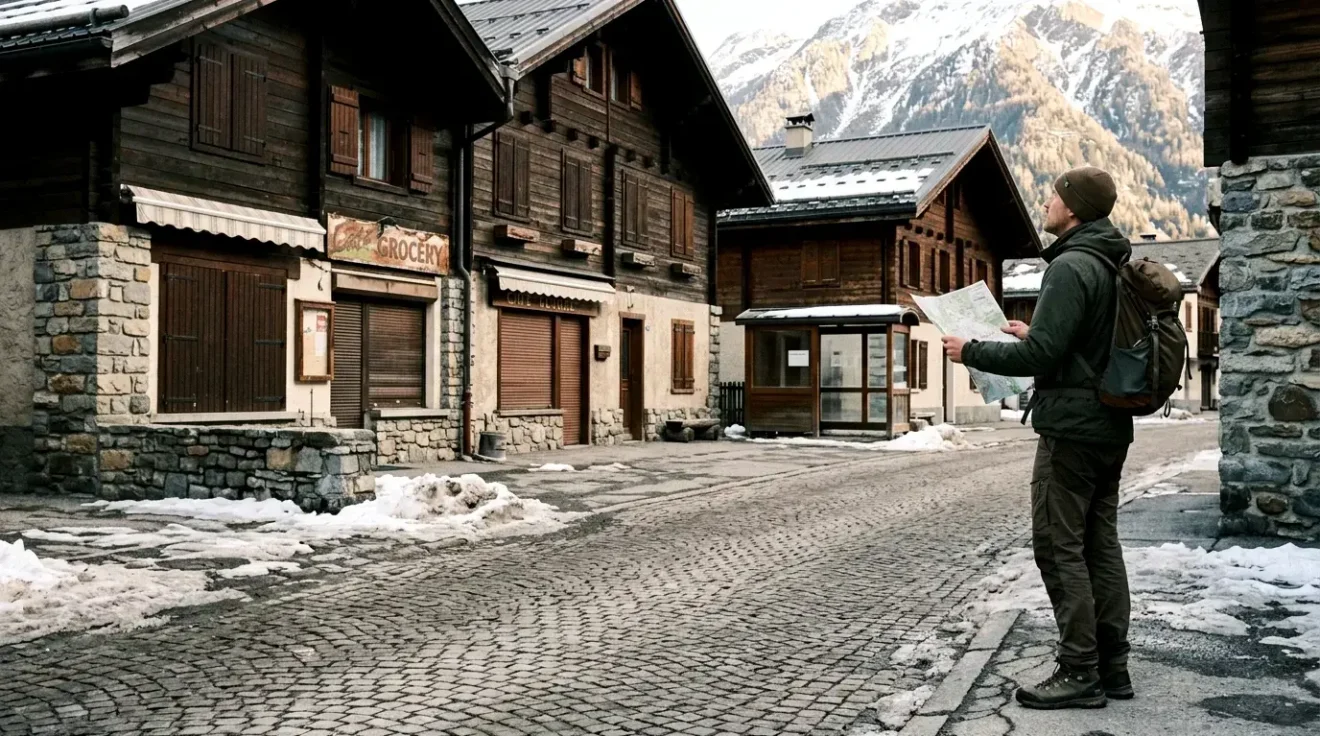
Satellite imagery helps identify settlement size and the actual distance between accommodation and services. Where available, street-level imagery can reveal steep approaches, stairs, narrow lanes and buildings that are less accessible than a conventional map suggests.
However, imagery may be outdated. A shop visible in a photograph might no longer operate, and an apparently convenient route may become difficult in winter weather.
Apply a fallback test: identify the nearest larger town, establish the practical journey to reach it and confirm whether that journey is available throughout your intended stay. Include the possibility that weather conditions could disrupt transport.
Travellers requiring reliable medical access, frequent shopping or flexible meal choices should place greater emphasis on these safeguards than visitors who are comfortable bringing supplies and arranging their own transport.
If the village passes this assessment, the next challenge is usually movement between settlements. Rural transport patterns may determine whether enjoyable day trips are realistic without a private vehicle.
How to Plan Village-to-Village Day Trips Using Regional Transport?
Plan village-to-village day trips by checking the return journey before selecting the outbound departure. Rural services may operate infrequently, follow commuter-oriented schedules or require advance booking. A successful itinerary depends on actual operating days, transfers and the final usable service, not simply the distance between villages.
Begin by identifying whether the area relies on regional trains, scheduled buses, demand-responsive transport or a combination of services. Trains can provide regular connections along established corridors, but many smaller settlements are reachable only by road.
Some rural bus routes concentrate services around commuting or school travel, potentially leaving long gaps during the day. Others are designed to provide broader access, including weekend connections. Frequency must therefore be checked route by route.
Ireland illustrates this variation. Transport for Ireland’s TFI Local Link service information distinguishes regular scheduled rural buses from door-to-door services. Certain door-to-door journeys require booking at least 24 hours in advance, and their frequency can range from daily to weekly or fortnightly.
The example demonstrates why the existence of a bus route does not automatically make a spontaneous day trip practical.
Two transport patterns deserve particular attention:
- Hub-and-spoke travel: A base in a well-connected market town provides access to several surrounding villages, with each excursion returning to the hub.
- Linear travel: Villages along a railway, valley or coastal corridor may be combined into one outward journey, provided the onward and return services align.
Both approaches work, but they require different checks. A hub provides greater flexibility when connections are frequent. A linear journey can reduce unnecessary backtracking but is more vulnerable to a missed onward service.
Five checks before confirming a rural day trip
- Identify the exact outbound and return stops on an official transport map. Deliverable: a saved route showing both stop locations.
- Find the final usable return departure for your intended day. Deliverable: a noted departure time and operating-day confirmation.
- Work backwards to select an outbound journey and realistic visiting window. Deliverable: a timetable with transfer and walking allowances.
- Verify booking, ticket purchase and validation requirements with the operator. Deliverable: a recorded purchase or booking method.
- Identify an alternative route or decide when the excursion must be shortened. Deliverable: a practical fallback plan.
Also review Sunday, public-holiday and seasonal timetables separately where applicable. Market days may influence passenger demand, while local events can affect routes or availability. Neither increased demand nor reduced service should be assumed without checking.
A village that looks close on a map may require hours of waiting if services do not connect. Conversely, a slightly more distant village on a frequent rail corridor can be easier to visit.
Even when transport is manageable, the timing of activities matters. In smaller Mediterranean towns, daily opening patterns can determine what travellers can realistically see between arrival and departure.
How Do Local Business Hours Affect Sightseeing in Small Mediterranean Towns?
Local business hours affect sightseeing because shops, restaurants, churches and cultural attractions may follow different daily and seasonal schedules. Midday closures can interrupt shopping or visits, while reduced off-season activity may limit dining choices. Travellers who plan around these patterns are less likely to arrive when essential services or attractions are unavailable.
Many Mediterranean towns have daily rhythms influenced by climate, local customs and the volume of visitors. Shops may close during part of the afternoon, while restaurant service follows defined lunch and dinner periods.
Italy’s official tourism portal, for example, describes some shops closing around 1 p.m. to 3 p.m., while others remain open continuously for much of the day. These are indicative practices rather than fixed rules for every town or establishment.
The official information also recognises geographic and seasonal differences. Tourist areas may have extended opening hours during busy periods, while some businesses operate more limited schedules outside the main season.
These differences matter when planning several activities in one day. A traveller might arrive in a historic centre at lunchtime only to discover that a small museum is closed, the local grocery shop will reopen later and the preferred restaurant has finished lunch service.
Rather than assuming that listings are always accurate, build a schedule around confirmed opening windows.
- Identify attractions with restricted admission times and plan those visits first.
- Cross-check the official local tourism office or attraction website for current schedules.
- Consult recent visitor information for indications of unexpected closures, without treating reviews as authoritative schedules.
- Contact smaller attractions directly when opening hours are uncertain.
- Leave flexible time for cafés, walks and shops rather than filling every hour with reservations.
The midday pause can also be useful. In hot weather, a slower lunch, indoor break or shaded rest period may be more comfortable than continuous sightseeing.
A hypothetical summer itinerary could place a church visit and market stop in the morning, reserve the warmest part of the day for lunch and rest, then continue with an evening walk when shops or attractions are operating.
This approach should be adjusted to confirmed local schedules. Some tourist centres operate continuously, and certain cultural sites may close on specific weekdays or public holidays rather than at midday.
Matching the local timetable can improve comfort, but time management alone does not guarantee easy sightseeing. The physical layout of historic streets is another important factor, particularly for travellers with limited mobility.
Key takeaways before choosing a historic town base
- A short walking distance on a map can conceal a steep climb, uneven paving or several flights of steps.
- Being able to visit a historic centre does not necessarily mean staying overnight in its upper streets is convenient.
- Accommodation access, luggage transfers and suitable rest stops should be verified before prioritising picturesque surroundings.
Why Picturesque Old Towns Can Be Difficult for Travellers With Limited Mobility
Picturesque old towns can be difficult for travellers with limited mobility because their historic layouts often include steep gradients, uneven cobblestones, narrow stepped lanes and restricted vehicle access. These features can make short journeys physically demanding or inaccessible. Checking the specific route between accommodation, transport and attractions is more reliable than judging accessibility from photographs or map distances.
Many historic centres developed before modern accessibility standards and vehicle-based transport. Their street networks may follow steep terrain, retain traditional paving and include stairways between different levels.
These characteristics contribute to their appeal but can create obstacles for wheelchair users, people who use walking aids, travellers with reduced stamina and visitors who find prolonged standing or uneven surfaces difficult.
Potential barriers include:
- Worn cobblestones that make walking or using mobility equipment less stable.
- Steep gradients without frequent places to rest.
- Stone staircases with irregular step heights or limited handrails.
- Narrow pavements and pedestrian routes shared with other visitors.
- Vehicle restrictions that prevent taxis from reaching accommodation entrances.
These obstacles vary considerably between individual towns and streets. Historic architecture does not automatically mean that an entire destination is inaccessible.

Before booking, examine the route from the nearest practical drop-off point to the accommodation entrance. Use elevation information and street-level imagery where available, paying particular attention to steps, slope changes, paving and opportunities to rest.
Accommodation listings require equally careful interpretation. A generic accessibility label may not explain whether the route from the street is step-free, whether there is a suitable lift or whether bathrooms meet a traveller’s specific needs.
Ask the property for precise details about entrances, stairs, lift dimensions where relevant, bathroom facilities and the nearest permitted vehicle drop-off point. Photographs of the actual access route may be more informative than general descriptions.
The distinction between visiting and staying in an old town can be decisive. A visitor might reach the main square through a relatively level entrance, enjoy several attractions and leave by an accessible route. Staying in accommodation higher up the hillside could require repeating a difficult climb several times daily.
Consider a hypothetical traveller who can walk short distances but struggles with sustained uphill routes. Accommodation near a flat harbour promenade, with planned visits to selected upper-town attractions, may offer a better experience than a room located deep within steep historic lanes.
Where available, official local accessibility resources can help establish accessible entrances, public transport options and suitable facilities. Their information should still be checked against individual requirements, especially if assistance or adapted transport must be arranged in advance.
Allow additional time for rest, minimise unnecessary backtracking and avoid relying on unverified shortcuts. A short, manageable sightseeing day can offer more enjoyment than an ambitious route through difficult terrain.
To make a final regional choice, compare two or three potential bases using the same criteria: local climate, transport, essential services, opening hours and accessible routes. Verify the conditions that directly affect your activities, then choose the location that makes your preferred daily routine practical rather than simply the one with the most attractive photographs.
How far in advance should local regional conditions be researched?
Investigate relatively stable characteristics, including geography, transport networks and typical climate, before booking accommodation. Recheck seasonal timetables, opening hours, transport arrangements and operational conditions closer to departure. For weather-sensitive activities, consult current forecasts shortly before travelling rather than relying entirely on historical averages.
Is it better to choose a regional capital or a smaller village as a holiday base?
A regional capital or transport hub may provide more convenient access to services and excursions, while a smaller village can offer a quieter setting and closer contact with local routines. Compare the actual connections, walking environment, accommodation location and daily facilities. A village is preferable when its atmosphere outweighs the additional logistical demands for your particular travel style.
Can regional climate averages reliably predict holiday weather?
No. Climate averages describe conditions observed over historical periods; they do not determine the weather during specific travel dates. They are useful for comparing typical monthly conditions between locations. Current forecasts, local weather warnings and the flexibility of planned activities remain important as departure approaches.
What should travellers verify when choosing a destination without renting a car?
Check the transport link from the arrival airport or railway station, the location of accommodation relative to stops and essential services, the frequency of local routes and the final return departure from potential day trips. Confirm weekend and holiday operation, ticket arrangements and whether any demand-responsive services require advance booking.
How can travellers assess a region’s atmosphere before arriving?
Examine the town’s everyday facilities, seasonal visitor patterns, public spaces and typical activities rather than relying exclusively on promotional photographs. Recent visitor accounts, local tourism information and street imagery can provide useful clues. However, atmosphere is subjective and can change with weather, festivals, school holidays and the time of day, so findings should be treated as indicators rather than guarantees.