
The best holiday destination is not necessarily the most famous, affordable or frequently recommended country. It is the place where your available budget, preferred activities, travel pace and dates fit together with the fewest compromises.
A traveller seeking quiet coastal villages and leisurely meals may find a heavily promoted capital exhausting. Someone who enjoys museums, nightlife and efficient public transport might feel restricted in an isolated seaside resort. Both destinations can be excellent, but neither suits every visitor.
Choosing effectively means looking beyond attraction lists. Accommodation prices change with the season, transport connections determine how much time you spend moving, and local weather can make an otherwise appealing itinerary impractical.
A useful destination comparison therefore starts with personal priorities, eliminates unsuitable options and tests the remaining countries against realistic itineraries. Whether you are planning your first overseas holiday or comparing familiar European destinations, this approach helps turn travel inspiration into a workable decision.
How to choose a holiday destination that fits
- Prioritise personal fit: Rank your essential requirements before comparing countries or following popular recommendations.
- Compare complete itineraries: Consider travel distances, accommodation locations, crowd levels and seasonal conditions rather than country averages.
- Budget for the actual experience: Include transfers, insurance, local charges and unexpected costs alongside flights and hotels.
- Why Do Famous Holiday Destinations Sometimes Disappoint First-Time Visitors?
- How to Shortlist Five Countries When Your Holiday Priorities Conflict?
- Portugal or Spain: Which Offers a Better Fit for a Two-Week Holiday?
- The Instagram Destination Trap That Can Ruin a Long-Haul Holiday
- Where to Find Quieter Alternatives to Europe’s Most Visited Holiday Hotspots?
- Northern or Southern Italy: Which Better Suits a Slow-Paced Holiday?
- How to Find Shoulder-Season Travel Dates Without Risking Poor Weather?
- How to Set a Travel Budget That Covers Hidden Holiday Expenses?
Why Do Famous Holiday Destinations Sometimes Disappoint First-Time Visitors?
Famous holiday destinations sometimes disappoint because their worldwide reputation creates expectations that everyday travel conditions cannot consistently meet. Photographs emphasise exceptional viewpoints, beautiful weather and memorable landmarks, while actual visits involve crowds, transport, queues and ordinary neighbourhoods. Disappointment often reflects a mismatch between expectations and priorities rather than a fundamental problem with the destination.
A destination’s reputation typically concentrates attention on a small number of attractions. Venice becomes its canals, Santorini its whitewashed buildings overlooking the sea, and Amsterdam its historic waterways. These images communicate genuine appeal, but they cannot represent everything involved in spending several days there.
Before deciding that a destination is overrated, ask three diagnostic questions:
- Did you expect an experience the destination was never designed to provide, such as complete solitude in a heavily visited historic centre?
- Did your chosen travel dates or visiting hours make the experience less comfortable than expected?
- Did crowd levels, prices or transport arrangements exceed your personal tolerance?
If the answers point towards timing or expectations, the destination itself may still be suitable under different conditions. If its basic character conflicts with your preferred holiday style, another country or region may be a better match.
Visitor-management arrangements reinforce the importance of planning. Venice, for example, operates a date-dependent access-fee system rather than a permanent year-round charge. According to Venice’s official access-fee information, the 2026 trial ended on 26 July, with no payment or exemption request required from 27 July. The municipality has announced the fee’s return in 2027, with further arrangements to be published.
An access fee should not be confused with a timed attraction ticket, guaranteed entry or a visitor cap. Likewise, arrangements for particular viewpoints and attractions must be checked individually rather than assumed from the city’s general tourism rules.
The most useful lesson is not to avoid famous places. It is to recognise which elements of a holiday matter enough to determine whether fame translates into personal enjoyment.
How to Shortlist Five Countries When Your Holiday Priorities Conflict?
To shortlist five countries with conflicting holiday priorities, first separate essential requirements from preferences, then rank the factors that matter most. Eliminate any country that fails a non-negotiable condition and score the remaining candidates against your three highest priorities. This prevents appealing but secondary attractions from overwhelming practical constraints.
Start by identifying five priorities from categories such as total cost, climate, cultural activities, food, accessibility and travel pace. Assign each a rank, with the most important receiving the highest weight. Then select the top three for comparison.
Must-haves act as elimination rules. If you cannot drive abroad and need reliable public transport, a car-dependent itinerary should be excluded even if its scenery and accommodation seem attractive. Likewise, a destination outside your maximum affordable budget cannot become feasible simply because its beaches receive excellent reviews.
For the remaining countries, a simple weighted score makes conflicting preferences easier to evaluate.
| Priority | Importance weight | Country A rating | Country B rating |
|---|---|---|---|
| Affordability | 5 | 4/5 | 3/5 |
| Cultural experiences | 4 | 3/5 | 5/5 |
| Slow travel | 3 | 5/5 | 2/5 |
| Weighted total | Maximum 60 | 47 | 41 |
These ratings are hypothetical, not evaluations of actual countries. The score is calculated by multiplying each rating by its priority weight and adding the results. Its purpose is to expose preferences, not to produce an objectively correct destination ranking.
Some conflicting priorities can be combined within one holiday. A traveller wanting both museums and relaxation might divide a fortnight between a culturally rich city and a nearby coastal region. This works best when the two bases have convenient connections. Long transfers, repeated packing and additional accommodation charges can eliminate the benefit.

To avoid confirmation bias, complete the priority exercise before searching for inspirational photographs or destination rankings. Otherwise, it becomes tempting to adjust your requirements to justify an attractive location.
Build a five-country shortlist you can actually compare
- Write down five holiday priorities in ranked order. Deliverable: a numbered priority list.
- Record essential limits for budget, travel dates, accessibility and transport. Deliverable: a written must-have checklist.
- Identify candidate countries and reject those failing any essential condition. Deliverable: a shortlist of no more than five eligible countries.
- Rate every eligible country against the top three priorities using the same scoring scale. Deliverable: a weighted comparison table.
- Draft one feasible itinerary for each leading option and check its major transfers. Deliverable: two or three realistic trip outlines ready for pricing.
Once the candidates meet your essential conditions, compare actual routes. Two neighbouring countries can produce surprisingly different holidays when their geography and transport networks are considered.
Portugal or Spain: Which Offers a Better Fit for a Two-Week Holiday?
Portugal often suits travellers seeking a compact two-week itinerary with a limited number of bases, while Spain offers a broader choice of regional experiences and extensive rail connections between major cities. Neither is automatically cheaper or easier. The better fit depends on which regions you visit, how frequently you move and the weather expected during your chosen dates.
Portugal lends itself to a route combining Lisbon, Porto and either the Douro Valley or the Algarve. Travellers can explore cities, regional food and contrasting landscapes without attempting to cover an exceptionally large geographic area.
Spain requires more deliberate regional selection. A fortnight focused on Andalusia offers a different experience from one spent in Catalonia or along the northern coast. Trying to combine distant regions may introduce transfers that compete with sightseeing time.
| Decision factor | Portugal | Spain |
|---|---|---|
| Suggested trip shape | Lisbon, Porto and one additional region | One main region or a carefully connected multi-city route |
| Travel pace | Well suited to a small number of bases | Supports both regional slow travel and connected city itineraries |
| Rail planning | Useful connections between principal cities; regional access varies | Extensive high-speed infrastructure linking multiple major cities |
| Budget sensitivity | Coastal seasonality and accommodation location | Regional differences, major-city demand and coastal seasonality |
| Weather considerations | Atlantic exposure and regional climate variation | Atlantic, Mediterranean and inland climate differences |
Spain’s rail infrastructure is a genuine advantage for certain multi-city trips. The network connects major centres including Madrid, Barcelona, Valencia, Córdoba, Seville and Málaga. However, infrastructure maps do not establish current passenger timetables, direct services or fares. Those must be verified for the intended travel dates.
Cost comparisons also depend on itinerary design. A popular coastal resort during its busiest period may cost more than an inland city in either country. Accommodation category, dining habits, car hire and hotel changes can affect the difference more than the national label.
For example, a hypothetical Portugal itinerary with three accommodation bases might involve fewer relocation expenses than an ambitious Spanish itinerary with six. A slower Spanish trip focused entirely on Andalusia could reverse that comparison. Neither outcome should be assumed without obtaining actual prices.
The calendar may settle the choice. Portugal’s Atlantic coastline and Spain’s Mediterranean regions experience different seasonal conditions. A beach-oriented holiday in an uncertain month needs more precise climate research than a museum-and-food itinerary.
Whichever country you choose, a coherent regional route is generally more useful than a long list of disconnected attractions. This becomes especially important when a destination’s visual reputation is influencing the decision.
The Instagram Destination Trap That Can Ruin a Long-Haul Holiday
Social-media travel imagery can distort destination choices by presenting exceptional moments as typical experiences. A photograph taken at sunrise, during a quiet season or from a restricted viewpoint may be impossible to reproduce during an ordinary visit. This becomes especially costly on long-haul holidays, where changing the principal destination may require substantial additional spending.
The problem is not necessarily misleading photography. It is the absence of context around the image. A spectacular coastal viewpoint may be photographed during favourable light, while the same location at midday offers harsher conditions, more visitors and limited space.
Some sought-after viewpoints also have specific opening hours, access restrictions or permit requirements. Never assume that a photograph proves unrestricted public access.
Before making a viral attraction the centrepiece of a long-haul trip, investigate three questions:
- Where was the photograph taken? Identify the exact viewpoint and verify whether ordinary visitors can legally reach it.
- When was it taken? Compare the time of day and season with your intended visit.
- What is the ordinary visitor experience? Examine recent traveller photographs and reviews discussing queues, access and crowd levels.
Long-haul travel makes these checks particularly important. A disappointing weekend destination may be relatively easy to revisit or replace on a future short trip. An expensive intercontinental itinerary usually involves more substantial commitments, including flights, accommodation and internal transfers.
A practical safeguard is to avoid building the entire trip around one photogenic attraction. Instead, assess the surrounding region for other activities that genuinely interest you. The famous location can then become a half-day excursion rather than the sole justification for travelling.
Keep one segment flexible where practical. This could mean reserving refundable accommodation for a secondary stop or leaving an uncommitted day near several possible attractions. Flexibility has a price, so compare cancellation terms before assuming it is financially beneficial.
The strongest long-haul itineraries remain worthwhile even when the headline attraction falls short. Finding quieter neighbouring destinations is one way to build that resilience.
Where to Find Quieter Alternatives to Europe’s Most Visited Holiday Hotspots?
Quieter European holiday alternatives are often found by preserving the qualities of a famous destination while changing its accessibility or location. Look for smaller towns, inland bases or neighbouring regions with similar scenery and food traditions but fewer direct transport connections. These options can reduce exposure to the busiest tourist areas, although they may also require more planning.
Start by identifying what makes the original destination attractive. If the appeal is Mediterranean coastline and seafood rather than a particular landmark, many alternative regions may satisfy the same interests.
Then change one variable: choose a less central town, travel outside the busiest weeks or accept an additional transport connection. This can reveal places overlooked by itineraries built around major airports and internationally recognised landmarks.
Several regional comparisons illustrate the trade-offs.
| Popular choice | Alternative to investigate | Main compromise |
|---|---|---|
| Croatia’s Dalmatian highlights | Slovenia’s short Adriatic coastline | Less coastline to explore and a different range of coastal experiences |
| Portugal’s Algarve | The Minho region in northern Portugal | Different Atlantic beach conditions and generally less emphasis on classic hot-weather resort holidays |
| Popular Greek coastal destinations | Selected coastal areas of Albania | Potential differences in infrastructure, transport convenience and English-language services |
These are options for further comparison, not guarantees of lower prices or fewer tourists. Individual towns can be busy even within less internationally recognised regions, particularly during local holidays or peak summer periods.
Another effective approach is to stay in a working regional town near a famous destination. Such places may offer everyday shops, restaurants serving residents and accommodation less dependent on short peak-season demand. The trade-off is the cost and inconvenience of travelling to headline attractions.
Check return transport as carefully as outward connections. A comfortable daytime excursion can become difficult if the final bus or train leaves before your preferred dinner time.
The phrase “hidden gem” also deserves scepticism. Once a destination becomes widely recommended, its popularity can change. A repeatable search method is more valuable than relying on a permanently quiet list of places.
For travellers who value unhurried days, the next decision is not simply where to avoid crowds, but which region supports a slower way of travelling throughout the holiday.
Northern or Southern Italy: Which Better Suits a Slow-Paced Holiday?
Southern Italy can be an excellent choice for a slow-paced holiday based around small towns, coastal scenery and regional food, while northern Italy often makes car-free travel between well-connected cities easier. Neither region is inherently slower. The better choice depends on your preferred base, willingness to drive, travel season and tolerance for seasonal closures.
Slow travel is not simply travelling fewer kilometres. In practical terms, it means reducing hotel changes, spending several days in the same area, exploring on foot and allowing time for meals or unplanned activities.
Southern regions such as Puglia, Basilicata and parts of Campania offer possibilities for this style of holiday. A traveller might choose one town and explore nearby villages, markets and coastal areas rather than attempting to visit every major landmark.
However, a slower atmosphere does not automatically mean simpler transport. Depending on the location, regional buses may be infrequent, and some rural or coastal areas can be easier to explore by car. Travellers uncomfortable with driving abroad should check the actual connections before choosing an isolated base.
Northern Italy offers a different advantage: numerous cities are linked by rail, making it possible to create a holiday with a small number of convenient bases. A traveller staying in Bologna, for example, can investigate nearby rail excursions without changing accommodation every night.
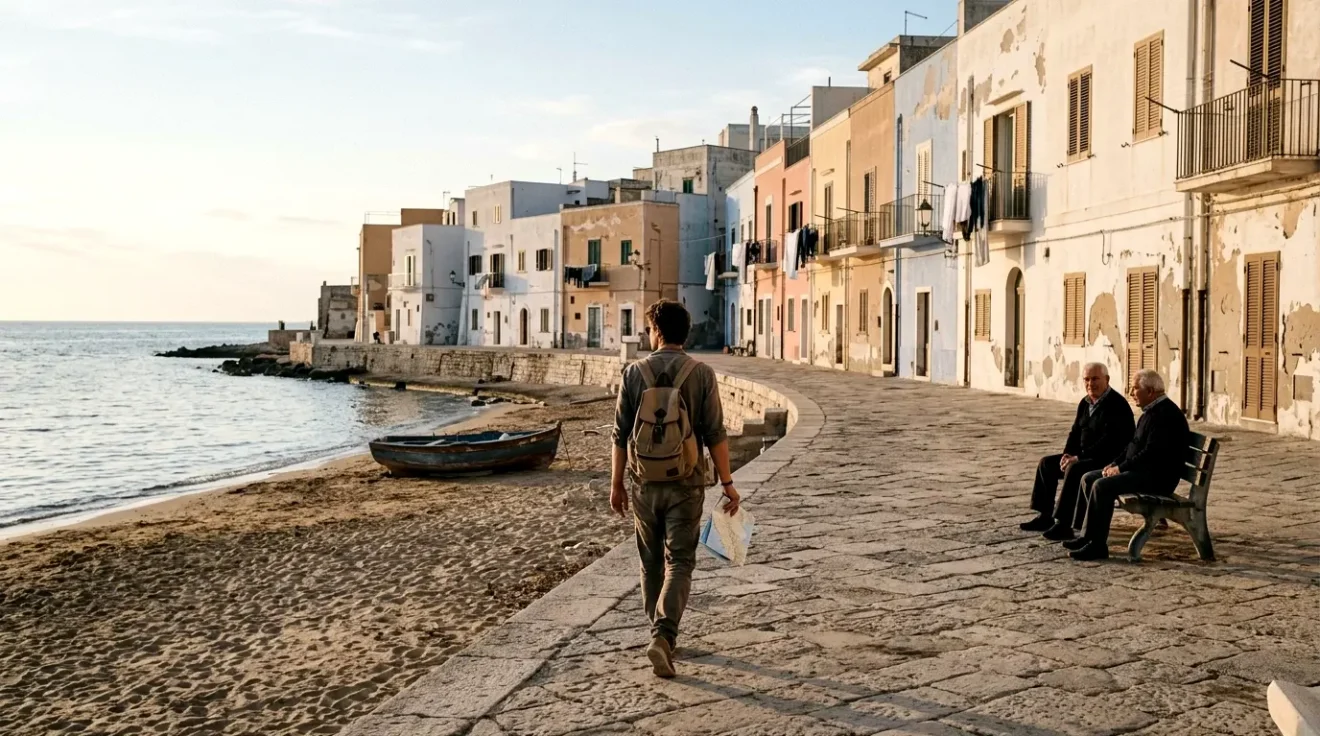
Seasonality can change the comparison. Some southern coastal resorts operate with reduced services outside their main visitor season. Northern cities with substantial resident populations may offer a more predictable choice of restaurants, cultural attractions and transport throughout the year.
That does not mean northern lake resorts are immune to seasonal closures, or that southern towns become inactive outside summer. The important distinction is whether the selected base has a functioning year-round community.
Budget considerations follow the same logic. Staying longer in one location may reduce intercity transport expenses, but a costly resort base can still make the overall holiday expensive. Grocery access, local dining options and the need for a rental car all influence the outcome.
A slow holiday works best when the destination supports your preferred daily routine without constant logistical effort. The remaining question is whether the travel dates support that routine as well.
How to Find Shoulder-Season Travel Dates Without Risking Poor Weather?
The safest way to select shoulder-season travel dates is to compare historical climate patterns for specific destinations and months, rather than assuming spring or autumn offers suitable weather everywhere. Temperature, rainfall and seasonal services vary considerably between regions. Historical averages cannot eliminate weather uncertainty, but they help identify when conditions are more compatible with your planned activities.
Shoulder season is not one universal period. An Atlantic coastal town, Mediterranean island and inland European city may experience substantially different conditions during the same month.
Start with the activities that matter most. Beach holidays are especially sensitive to air temperature, water conditions and rain, while museum visits, food tours and urban sightseeing can remain rewarding in less predictable weather.
Next, consult national meteorological services for monthly climate normals. Portugal’s meteorological institute, for example, explains its methodology and reference periods in IPMA’s explanation of Portuguese climate normals. Its available reference periods include 1991–2020, alongside earlier historical periods.
Climate normals describe historical averages rather than a forecast for your specific holiday. They are most useful for comparing typical conditions between months and locations, not predicting whether a particular Tuesday will be dry.
Compare average daytime temperatures, rainfall totals and, where available, the number of wet days. Monthly rainfall totals alone cannot reveal precisely when rain will occur or how long individual showers will last.
Evaluate rain by its impact on the trip. An afternoon of wet weather may disrupt a beach day but have little effect on an itinerary with museums, cafés and indoor markets.
To manage uncertainty, build an itinerary with several interchangeable activities. Where the additional cost is acceptable, refundable accommodation may protect a weather-sensitive part of the trip. A flexible middle segment also allows some activities to be rearranged without changing international flights.
Shoulder-season travel can offer lower accommodation prices and fewer visitors, but neither benefit is guaranteed. Reduced demand may also bring shorter opening hours, limited ferry schedules or fewer seasonal excursions.
For this reason, check two things before paying: whether the climate suits your essential activities and whether the services needed to enjoy them will operate.
Weather flexibility is valuable only when it remains affordable. Refundable bookings, alternative transport and seasonal price differences therefore belong in the final holiday budget.
Key takeaways before you commit your budget
- A destination that meets your priorities can still be unsuitable if its most practical itinerary exceeds your financial limit.
- Transport frequency, hotel changes and cancellation conditions can affect total spending as much as accommodation rates.
- Compare complete trip costs using the same dates, comfort standard and travel assumptions before making a final choice.
How to Set a Travel Budget That Covers Hidden Holiday Expenses?
A realistic travel budget begins with the full cost of reaching, staying in and moving around your destination. Price flights, accommodation and intercity transport first, then add daily expenses, insurance, local charges and a contingency for unexpected costs. This itemised approach is more reliable than assuming that a fixed percentage will cover every destination’s hidden expenses.
Start with the fixed structure of the trip. Flights, accommodation and necessary transfers establish the minimum financial commitment. Add any advance expenses such as travel insurance, car hire or essential reservations.
The UK’s MoneyHelper service recommends this itemised approach in MoneyHelper’s holiday budgeting guidance, separating major travel arrangements from daily spending on food, entertainment and excursions.
Once the main costs are identified, calculate daily variable spending for the exact itinerary rather than using a generic national allowance. A capital-city stay with frequent restaurant meals and paid attractions may require a different allowance from a small-town holiday with self-catering accommodation.
Finally, investigate expenses commonly missed during early planning:
- Airport and regional transfers: transport between airports, railway stations, accommodation and smaller towns.
- Local visitor charges: applicable tourist taxes or municipal access arrangements, checked for the actual dates and accommodation type.
- Payment costs: card foreign-transaction fees, ATM charges and potential currency-conversion costs.
- Insurance and reservations: appropriate travel cover, attraction tickets and booking charges where applicable.
- Contingency expenses: unavoidable changes, replacement transport or unexpected accommodation costs.
Venice illustrates why date-specific verification matters: its 2026 access-fee trial is over, and the announced 2027 arrangements should not be treated as finalised prices or rules before the municipality publishes them.
A simple build-up calculation makes the method repeatable.
Hypothetical example: budgeting for a two-week European holiday
Assume a traveller has estimated flights at £300, accommodation at £900, intercity and airport transport at £180, and daily meals and activities at £55 for 14 days. These are illustrative figures, not actual destination prices or recommended spending levels.
The initial cost is £300 + £900 + £180 + (£55 × 14), giving £2,150. If the traveller then identifies £140 of additional insurance, local charges and payment expenses, and chooses a £200 contingency based on their own risk tolerance, the working budget becomes £2,490.
The exercise demonstrates how individually modest omitted expenses can change the required savings target. Actual costs must be checked against the selected destination, dates and travel arrangements.
Travel style changes where money is spent. A base-based itinerary can reduce relocation expenses while increasing the proportion allocated to accommodation and local activities. Frequent hotel changes may introduce additional transport, baggage storage or transfer costs.
Long-haul travellers should also account for exchange-rate changes between booking and departure. Shoulder-season travellers may need to consider limited transport services or the cost of changing bookings when the weather disrupts their plans.
Rather than applying one arbitrary contingency percentage to every trip, identify the risks that remain after confirmed bookings and choose a reserve consistent with those potential costs and your financial capacity.
Choose the destination whose realistic total cost fits your available budget without compromising your most important experiences. Before making non-refundable bookings, obtain current prices for the leading itinerary, verify travel requirements and confirm that enough money remains for unexpected expenses.
Should first-time international travellers choose one country or visit several?
One country is often easier for a first international holiday because it can reduce border crossings, complicated transfers and repeated adjustments to unfamiliar transport systems. Visiting several countries can still work when distances are short, connections are convenient and the itinerary allows enough time in each destination. Compare the practical travel requirements rather than the number of countries alone.
How many nights should you spend in each destination on a two-week trip?
There is no ideal number for every traveller. For a relaxed fortnight, two or three accommodation bases can provide a useful starting point, with stays adjusted according to activities and transport connections. Longer stays suit people who enjoy local routines, while shorter visits may be reasonable for compact cities with efficient connections. Count transfer time as part of the holiday, not as free time.
Is travelling outside peak season always cheaper?
No. Accommodation demand, school holidays, festivals, flight availability and local events can affect prices independently of the usual peak season. Some destinations may also have reduced transport services outside summer, increasing the cost of reaching particular attractions. Compare complete itineraries for specific dates instead of assuming every shoulder-season trip is cheaper.
Should you book flights before deciding on your holiday itinerary?
Usually, it is safer to establish a feasible itinerary and approximate total cost before committing to non-refundable flights. An attractive airfare may conceal expensive onward transport or limited accommodation availability. Check entry requirements, arrival times, regional connections and cancellation conditions before purchasing, particularly for long-haul or multi-stop holidays.
How can you tell whether a cheaper destination offers better value?
Compare the cost of obtaining the experiences you actually want. A country with inexpensive accommodation may be poor value if reaching its main attractions requires costly transfers or a rental car. A more expensive location with walkable neighbourhoods, convenient transport and suitable activities may offer better overall value. Use comparable dates, accommodation standards and trip lengths for a meaningful assessment.